Class List
Alphabetic -
Categoric - Chronologic
Gift Certificates are available for most classes.

ABANA Conference
 ABANA has a conference biennially.
Smiths show up from ALL over.
If you can get to it, it's worth the effort.
You can ignore the rest of the PHF class-related boilerplate text and just click through to the ABANA website
Class tuition to be determined.
Full Description, Dates, and Registration Information.
Back to TOP
Aluminum Casting with the Coal Forge
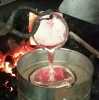 We'll be exploring the aluminum casting technique known as 'The Foam Vaporization Method' or 'Lost Foam'.
A model is made of styrofoam, buried in loose dry sand, and poured with molten aluminum. We'll be using our coal forges and mostly scrounged materials to cast at least one small item per student.
This technique is less precise than 3D printing, but much much faster. We'll talk about how to do it "on-the-cheap".
You should make a model or two to try casting during class:
Make it out of styrofoam. Either the white chunky bead foam or the 'solid' stuff; the blue and pink insulation foams work well, so do foam meat trays and restaurant take-home containers. Styrofoam cups work. You can use rubber cement, double-face tape, even cellophane tape and masking tape to hold parts together.
Note: Green florist's foam Does. Not. Work. (we tried it)
Keep in mind that the metal will shrink as it cools, the final casting will be a tiny bit smaller than the model you make.
For the purpose of the class I would recommend that your model be no larger than 2" in any direction, and definitely less than 8 cubic inches in volume, whatever the dimensions.
Until you have some idea what you're doing with this technique (which is what this class is for) I wouldn't recommend investing _lots_ of time in a highly detailed model unless, of course, you're doing it as a test.
It is fairly easy to get fine detail on one side, maybe two of your model, the opposite sides, not so much. On the good side, the indentations left by writing with a ballpoint pen will be preserved in the metal.
3 hours, one meeting $125
Full Description, Dates, and Registration Information.
Back to TOP
Andover Celebrates the Semiquincentennial (or Bisesquicentennial if you like)
 Along with several (many?) other AmRevWar craftspeople, we will be demonstrating ours on the Town Green next to Town Hall.
We'll be forging well, with goods to sell, and many engaging stories to tell.
Carl grew up in Andover and left the same year he took up Blacksmithing.
Forty-nine years later he returns for a visit as an actual Professional, prizewinning Blacksmith.
Aside from that particular tid-bit, this will be a fairly typical demo/sales/come-take-a-class-with-us event.
Come watch Earth's most abundant element shaped to Human Will!
Start to finish of the event No known fee or admission......
Full Description, Dates, and Registration Information.
Back to TOP
Applied Ironcarving Workshop
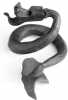 If you've made a dragon head, maybe in Rudiments II or Ironcarving, here's a chance to do it again larger, better, with more detail, already having some idea of what you're doing. We'll be focusing on achieving aesthetic success with forging and carving techniques you already know. The learning part of this class will be more about the 'where' and 'why' and less about the 'what' and 'how'.
You'll have the option of working with larger (3/4") stock to make a piece suited to incorporation into a door knocker, sign-bracket, wall sconce, or use as a serious paperweight, bottle opener, objet d'art... If needed, on the thick sections, we will strike for each other as we do at Striker Team.
If you want to do some other creature than a dragon, that's a perfectly fine thing, there are a multitude of descriptions of heads and how to forge them in books and on the net. If you know ahead what you'd like to do, please drop us a note with a description or pointer to one, so we can check to see if we have the tools necessary. If you think you'll need a striker, tell us that too.
This 'class' takes the form of a 'Guided Open Studio'; the instructor is there to help you through your project, not so much telling you what to do, as helping you figure out how to do it.
6 hours over two meetings Fee: $250
Full Description, Dates, and Registration Information.
Back to TOP
Arrowhead: The armor-piercing bodkin point
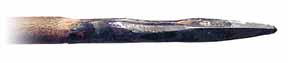
We will make a classic medieval bodkin point or two, maybe three.
The techniques are flattening, curling, cutting on the hardy, and drawing
out. There will be a strong focus on hammer control, symmetry
in the work, and working in very thin sections.
There will be a discussion and demo of techniques for weighting and
mounting the heads for target archery use.
3.5 hours one meeting Fee: $140
Full Description, Dates, and Registration Information.
Back to TOP
Arrowheads and other hollow, conic forms
 Part of our Sundays at the Forge series.
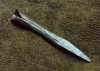
We will make a classic medieval bodkin point or two, maybe three. In the process we will have a chance to explore a shape that can be made larger and used as a candle-cup or smaller and used as an aiglette.
The techniques we will use are flattening, curling in the step, cutting on the hardy, and drawing out. There will be a focus on hammer control, symmetry in the work, and working in very thin sections.
2 hours one meeting (See our Bodkins class)
Full Description, Dates, and Registration Information.
Back to TOP
Bachelor Party or Bridal Shower -- Private Party
 This is a Private Party. Unless you're on the guest list, you can't attend. However, if it sounds like a Really Cool Idea, you're right, and you can contact us to make arrangements for your own Bachelor Party, Bridal Shower, Birthday Party, Bar Mitzvah, or what-have-you.
Variable Variable
Full Description, Dates, and Registration Information.
Back to TOP
Basics of Blacksmithing
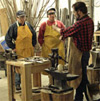 We no longer offer Basics as a monolithic class, the same content is in our Rudiments I, II, and III classes.
You will be exposed to the
basics of the language of blacksmithing. From "smash-it-flat" to forge
welding. There will be practice pieces, exercises, samplers, problems,
and actual projects all aimed at building your smithing vocabulary and
fluency. By the end of the series you should be well on your way to
thinking like a blacksmith.Class tuition to be determined.
Full Description, Dates, and Registration Information.
Back to TOP
Birthday at Tail in the Mud Pottery
 Tail in the Mud Pottry Studio (our neighbors -in- the building) are celebrating a year in business and we are celebrating with them.
We may demonstrate some of the wonders of blacksmithing. There will probably be some clay on the wheel at Tail in the Mud Pottery in the other end of the building.
We will convert forge 3 to a grill by charging it with charcoal instead of coal (feel free to bring things to cook on a stick or grill [but please no raw chicken or pork]),
and we plan to mull cider properly... with mullers and loggerheads.
Unlike most barbecues, weather doesn't change our plans, we are set up to do it indoors.
There will be tables of ironwork and pottery for sale but there will be no high-pressure sales talk; it's a party and we're here to enjoy it too.
But hey, if you ask about taking classes or learning about blacksmithing or pottery...
Directions to the smithy.
Usually a full afternoon or a full evening No admission fee, but feel free to bring something to throw on the grill, or cook on a fork.
Full Description, Dates, and Registration Information.
Back to TOP
Blacksmith House - A Public Demonstration
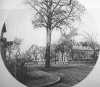 We'll be demonstrating Blacksmithing while standing over the remains of the roots of the very chestnut tree (the one in the picture) mentioned in Longfellow's poem.
For official information Click here and scroll down.
About 4 hours There is no admission fee.
Full Description, Dates, and Registration Information.
Back to TOP
A Blacksmithing Demonstration
 This is a generic listing for a demonstration that may just be a one-off... but may become a regular thing, we don't know yet.
Time and place information is below.
Start to finish of the event usually No known fee or admission... Free.
Full Description, Dates, and Registration Information.
Back to TOP
Boy Scout Metalworking Merit Badge
 In Session One, the scouts learn a bit about safety in the smithy and basic smithing skills such as forging, bending, curling, twisting and annealing. They do so in a way that satisfies the BSA MB requirements to make a right-angle and a U-shaped bend, taper to a point, twist hot steel, and work-harden and anneal non-ferrous metal. During the course of all that, we have them make a useful and hopefully decorative wall hook, which we help them hot-punch so it can be hung up at home.
In Session 2, they make a simple center-punch, a temper-color index and a piece of their own design, using the skills they've learned and adding solid riveting as well. The design for this piece is to be vetted by the MB counselor before Session 2.
Session 1 is about 2.5 hrs, Session 2 is about 3.5 hrs. Tuition: $700 for as many as four students, $1000 for five to eight students.
Full Description, Dates, and Registration Information.
Back to TOP
Bracelets II
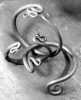 We'll use traditional blacksmithing techniques to make a distinctly non-traditional item.
We'll work an iron bar with fire and water, hammer and tongs, vise and
anvil and learn about heat control, hammer control, and self-control
while creating an iron bracelet with a tapered, sinuous motif.
We'll use traditional blacksmithing techniques to make a distinctly non-traditional item.
We'll work an iron bar with fire and water, hammer and tongs, vise and
anvil and learn about heat control, hammer control, and self-control
while creating an iron bracelet with a tapered, sinuous motif.
Techniques will include forging (drawing out, tapering, square-octagonal-round), bending, twisting, and planning ahead.
Two 3 hour meetings Fee: $150
Full Description, Dates, and Registration Information.
Back to TOP
Butterfly Hinges
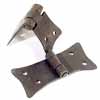 In this class you will make a pair of simple butterfly hinges, suitable for use on a cupboard, small chest, or box.
You will learn how to form the eye around the pin, how to adjust the eye so that the hinge turns, how to make the second leaf fit the first, and how to put them together.
This class is 2 sessions long. Each session is 3 hours.
Fee: $250
Full Description, Dates, and Registration Information.
Back to TOP
Calligraphy for Blacksmiths I
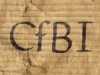 We will be learning to draw the Roman alphabet. First as what my calligraphy professor, Arnold Bank called "Simple Hand"; an un-serifed version of the letters you are probably reading right now. The focus will be on shape and spacing. Then if time and class progress permit, we will move on to serifed Roman.
The Roman hand is deceptively simple-looking and plain. It is perhaps the least forgiving of any calligraphic hand, you cannot hide mistakes with fiddly gew-gahs. Being able to do it well is no small achievement.
Know this ahead: It will be frustrating, you will make a lot of ugly letters. It's OK.
There will be homework. If you do it, it will show in the quality of your work, both at the board, and at the anvil.
12 hours in 6 two-hour meetings Tuition: $300
Full Description, Dates, and Registration Information.
Back to TOP
Cambridge River Festival
 Just upstream from the Weeks Memorial Footbridge, we'll be demonstrating traditional blacksmithing techniques, and the Striker Team will put in an appearance with their two-handed sledge hammers. Free! Children half price!
Full Description, Dates, and Registration Information.
Back to TOP
Carving a Simple Dragon Head
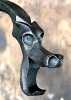 The project for this class will be carving a dragon head on the end of a 1/2" square bar.
It's a "simple" head in that there is not a lot of ornamentation or detail, those can be added in future versions.
The process calls for decent stock and hammer control and awareness of angles. The main skills used in this project are: the setting of shoulders and using driven tools to cut and re-shape the material.
Typically we finish the head out so it will serve as a bottle opener, but there are other options.
We will be using Zoom as the group-meeting app.
Clicking the link above will tell you what you need to make it go on your device.
The Zoom meeting URL will be emailed out at least an hour before class and the meeting will be started 15 minutes before official class start so we can check the tech and maybe visit each other's smithies.
People on the standby list will have the option of auditing the class (see the fees below) but will be asked to turn off their cameras and microphones until the end of class (emergencies excepted).
The student must have: (please read this carefully)
- Their own blacksmithing set up:
- A forge, lit and running by the beginning of class, type is unimportant
(being able to back-down a gas forge while we're talking would likely be good)
- An anvil-like object with a relatively sharp, but not sharp sharp edge.
- A hammer, 1.5 to 2.5 pound, no larger.
- A smaller hammer (~8oz)
- A softie (a flat wooden hardy tool soaked in water.) or a chunk of wood to grip in the vise.
- If your stock is short, tongs to hold the stock.
- A vise, solidly mounted. You'll be hammering in it.
- A straight chisel
- A conic pointed punch, the included angle of the point should be less than 90 but more than 60 degrees, and fairly sharp.
- A holder for the punch and chisel will make it easier to use them. A vise-grip, a tool-holder tongs, a dedicated tool holder...
- Eye and ear protection
- Ear buds or somesuch that fit under your ear protection so that you can hear me while you're hammering.
- A device that will run Zoom, has a camera, a microphone, and a decent 'net connection while in your work area.
- The ability to move that device around the work space so I can watch you work from helpful angles. A photographer's tripod and some way to hold your device on it would be marvelous
- Enough light. So both of us can see what you're doing
- If you're willing to give a brief tour of your set-up before class, that'd be cool.
Materials
At least 12" of 1/2" square steel, preferably mild. 24" or longer is better.
If it's 18" or more long you won't *need* the stock-sized tongs.
4 hours Fees: Participating $100, Auditing - Free, come see how it works.
Full Description, Dates, and Registration Information.
Back to TOP
Connecticut Blacksmiths Guild meeting at Mystic
We may or not be there, depending on scheduling, but this is the info from the Connecticut Blacksmith's Guild site:
CBG Winter Meeting
Driggs Blacksmith Shop, Mystic Seaport, Mystic, Ct
1pm – 4pm
Bring Items for the `Iron in the Hat’ Raffle
For more info contact: Bill Sheer, mysticbs@aol.com, (860)536-0679(it is unclear whether there is any fee)
Full Description, Dates, and Registration Information.
Back to TOP
Corkscrews
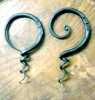 In this class we will make a corkscrew suited to opening even the finest of wines.
Unlike most modern, mass-produced, skinny little corkscrews, this design grabs a whole bunch of cork, not just the bit down the middle.
With one of these you will never find that, instead of removing it, you have just drilled a ragged hole in that piece of bark that's keeping you from your wine.
"You're going to have to change this design... It makes wine toooo accessible." - A.Z. (student who made a nice one. Then tested it.)
These make nice gifts (especially when you demonstrate that it really does work, on that bottle of nice wine you brought along).
Carl's note:
I'd had the idea of a corkscrew festering in my head for a long time, thinking that there must be a slick way of doing it. At the '10 NEB Fall Meet, Russell Pope had one on display. So I asked him about it and before he was twenty words into the explanation, the technique was clear. They don't quite make themselves, but it sort of feels that way.
3 hours, one meeting $125
Full Description, Dates, and Registration Information.
Back to TOP
Corkscrews, the online class.
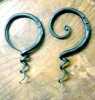 In this class we will make a corkscrew suited to opening even the finest of wines.
Unlike most modern, mass-produced, skinny little corkscrews, this design grabs a whole bunch of cork, not just the bit down the middle.
With one of these you will never find that, instead of removing it, you have just drilled a ragged hole in that piece of bark that's keeping you from your wine.
"You're going to have to change this design... It makes wine toooo accessible." - A.Z. (student who made a nice one. Then tested it.)
These make nice gifts (especially when you demonstrate that it really does work, on that bottle of nice wine you brought along).
The student must have: (please read this carefully)
- Their own blacksmithing set up:
- A forge, lit and running by the beginning of class, type is unimportant
(being able to back-down a gas forge while we're talking would likely be good)
- An anvil-like object with a relatively sharp, but not sharp sharp 90 degree edge.
- A hammer, 1.5 to 2.5 pound, no larger.
- A smaller hammer (~8oz)
- Tongs to hold the stock straight at least, crosswise can be helpful.
- A corkscrew opening tool. Description and instructions.
- A bending 'U' would be useful but not vital
- A bucket of Super Quench. Useful stuff, worth the time to get and make.
- Eye and ear protection
- Ear buds or somesuch that fit under your ear protection so that you can hear me while you're hammering.
- A device that will run Zoom, has a camera, a microphone, and a decent 'net connection while in your work area.
- The ability to move that device around the work space so I can watch you work from helpful angles. A photographer's tripod and some way to hold your device on it would be marvelous
- Enough light. So both of us can see what you're doing
- If you're willing to give a brief tour of your set-up before class, that'd be cool.
Materials
At least 14" of 1/4" round steel, preferably mild. 24" or longer is better.
If it's 18" or more long you won't *need* the stock-sized tongs.
3 hours, one meeting Fees: Participating $75. Auditing - Free, come see how it works.
Full Description, Dates, and Registration Information.
Back to TOP
A Corporate Team Experience
Whether it's to build team cohesion, to celebrate a release, a finished project, or some other milestone...
... Getting the group together to beat the everloving snert out of a piece of incandescent steel is a pleasant change of pace.
These sessions typically start in the late morning or early afternoon on a weekday
(earlier is possible, but there's an additional fee for getting the instructor up early) and run for three to three-and-a-half hours.
Eight students is our usual maximum.
We can handle as many as 12... that's our hard maximum, there just isn't room for more.
But once there are more than 8 students, even just one more, it adds about one-and-a-half hours to how long the session will last.
We -can- bring the forges to your place and do it as a Forge-to-Go class and maybe have a morning group and an afternoon group.
We can plan to include a break for lunch.
There are several places nearby in Waltham that make good food, and we have an excellent caterer a block-and-a-half away.
"What will we make?" I hear you ask.
Our Forged Bottle Opener Class usually fills the bill nicely, but if you want to work out something different... it's all negotiable.
To get started setting something up (the date, the time, the project), reach us by phone (after 10am): 781 816 9433
3 to 5.5 hours depending. Or maybe all day. Tuition: negotiable
Full Description, Dates, and Registration Information.
Back to TOP
Cubicle Hooks
In this class we will make a wrought iron piece to hook over the top edge of a cubicle-wall, with a functional coat/purse/backpack hook on the inside and an interesting detail on the outside.
The techniques involved will be drawing out, cutting, curling and bending.
Before coming to class, students should take a measurement of the thickness of the cubicle wall they want the hook to fit.
"Cubicle Hooks" counts as "A Taste of Blacksmithing" as far as pre-requisites for other classes.
3 hours, one meeting $95
Full Description, Dates, and Registration Information.
Back to TOP
A DIY Off-the-Grid Guerilla Patternwelded Billet
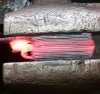 We'll be making a small (~1/2" x 1/2" x 5") billet or two of pattern-welded steel, what many call "Damascus Steel".
We will work with readily available steels (mild, strapping, hacksaw, transformer, bandsaw, bedrail...) to create a billet of layered steel that can be used to make any number of ornamental items (cufflinks and studs, door handles, buckles, forks, spoons... maybe the side plates on a San Mai Knife perhaps? Just... sayin'.)
We'll discuss various ways of affecting the pattern... twisting, drilling, grinding, folding, cutting... then choose one to try.
The expected 'product' of this class is... a chunk of metal. With which something cool may be done.
Note: We'll be spattering molten borax around the room, dress appropriately.
9 hours in 3 three hour meetings $375
Full Description, Dates, and Registration Information.
Back to TOP
Demo-to-Go
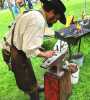 We come to your teaching-place and give a live, distanced, demonstration of the Craft and the Art of Blacksmithing to your class, answering questions as they arise, dispelling myths and misconceptions as we go.
A blacksmithing demonstration can be an interesting, even exciting and inspiring, adjunct to studies of:
The Iron Age
The Medieval period
Early Europeans-in-the-Americas
The History of Technology or of Engineering...
We will bring all that is necessary to demonstrate the sorts of things that a blacksmith might do to make tools, household implements, farm equipment, nails, (and because there's almost always the question, swords), or whatever seems most fitting for what is being studied.
We are prepared to discuss the making of iron from ore, the making of steel from iron (pre-Bessemer process), annealing, hardening, and tempering... depending on the interests of your students.
The equipment we bring typically consists of:
- A 123 pound anvil
- A coal-fired forge
- A lever-driven double-chamber bellows (good 14th-Century technology)
- A bench with a blacksmith's vise
- A bucket for quenching-water (we can bring the water too, but if there's a spigot available nearby, that's usually a little easier)
- A variety of hammers and other hand tools
We'll need a space about 10 x 15 feet, well away from buildings and their air-intakes. We can work on pavement or on grass. Being able to set up in the shade and have the students in the shade also would be a bonus while the weather is warm, when there's snow on the ground, it is less important.
Most aspects of this experience are negotiable.
This is a privately-arranged class, Demo-to-Go sessions listed below have been scheduled by someone for their own class groups.
If you are here to register for a session, please be sure you are doing so for the right one.
If you'd like to discuss scheduling a Demo-to-Go, please call Carl at 781 81oxide (781 816 9433) after 10am.
Calling is best, emails and texts can get lost in the flood.
[some of the information below is boilerplate, applicable only to our in-house classes, please don't be confused]
Class length is negotiable, but typically 3 hours Fee: typically $300 for roughly an hour to hour-and-a-half demonstration
Travel more than an hour from Waltham will be a bit extra
Full Description, Dates, and Registration Information.
Back to TOP
Elements of Household Racks
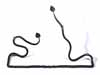 In this class we will address the techniques necessary to produce a towel rack, be it wide or narrow, intended to hold an elegant cloth towel or a roll of toilet paper.
With the techniques learned in this class the student will be able to go on and make an entire kitchen or bathroom suite of racks and holders.
This class is a single session of 3 hours. Fee: $105
Full Description, Dates, and Registration Information.
Back to TOP
An Evening of Sales (and schmoozing)
Sort of like when we're at a fair or festival, we'll have ironwork and Gift Certificates out on display and available for purchase, some amount of munchies, and some beverages.
We'll probably be mulling cider, probably toasting marshmallows.
Let's make an evening of it. There is no fee for this event
Full Description, Dates, and Registration Information.
Back to TOP
Exploring Blacksmithing II
 For intermediate students, this is an opportunity to work on your own projects under the supervision and direction of a teacher (as opposed to Open Smithy, which has no supervision). Periodically, the teacher will assess the class skills and suggest a topic to work on together for a week or three.
New students can join the class at appropriate times (i.e., not in the midst of a group topic) for a minimum of 4 weeks.
4 2.5 hour sessions, meeting once a week $320 for 4 weeks.
Full Description, Dates, and Registration Information.
Back to TOP
Exploring Fold Forming
 This is more a 'session' than a 'class', it is a chance to work with the technique in general or to spend the evening investigating the variations on a particular fold. Most sessions will begin with a brief demonstration of a particular fold or some aspect of hammering or opening. (if there's something in particular you'd like to see in the demo, make a note of it when you sign up and we'll do what we can.)
The session will go for a couple of hours and after that there will be an hour or two of Open Smithy available for those who wish to continue.
We will have 16oz/24ga/~.022" Copper sheet and ~16ga/.057" mild steel available for purchase, or you can bring your own material (no lead, no galvanized or plated steel).
2 hours per session $35
Full Description, Dates, and Registration Information.
Back to TOP
Field trip to Higgins Armory Museum
 We'll be arriving at the museum around noon, and staying till about 3:00, then moving to a local burger joint (Wild Willy's) for a late lunch. Carl will give brief impromptu lectures on various aspects of the armor on display (as of course will the museum guides and some of the other folks who are joining us).
Some of us will be carpooling from the forge. If you're interested in being one of that group, drop us a note to let us know to expect you, and make sure we have your cell number (if you have one).
Wild Willy's, where we expect to go for late lunch after the Higgins, has ample seating for the number of people we expect, is near the museum (a short drive, not really a walk), has GF options, but does NOT have much to offer vegetarians -- fries (good ones!) and salads and that's about it. They *do* have ice cream and frappes, though, for what that's worth. So, if you're a vegetarian/vegan/piscatorian, please bring a bag lunch so you can stay with the group for the social experience.
(http://www.wildwillysburgers.com/grub.cfm)
We're not organizing this enough to attempt to get a group rate. Admission is $12 for adults.
Roughly three hours, one meeting $12 for adults, with appropriate discounts for kids and families.
Full Description, Dates, and Registration Information.
Back to TOP
Fire Tools
In this intensive class you will make a set of fire-tending
tools; a poker, a shovel or hoe, a brush, maybe a pair of tongs, and a
wall mounted holder for the set.
We'll break for a one hour lunch around noon, and a shorter break sometime in the afternoon.
This is going to be a long day with a lot to get done.
One 8 hour session. $275
Full Description, Dates, and Registration Information.
Back to TOP
Fire and Hammerskills
 In this class there is no project per se, it's a chance to work on the skills and knowledge needed for lighting and running the fire, and to work on (improving) hammer technique for use in class and on personal projects. There will likely be a sidebar on choosing and using tongs.
We will do a _lot_ of hammering.
We will work on joint-safety, efficiency, power, control, and hammer-choice for the job.
We will intentionally make mistakes so that we can see the trouble they cause.
In the end we will have most of a horribly-abused piece of stock to show for our efforts, and a better understanding of our tools, what they do, and how they do it.
This class will be of value to novices who've only had a couple hours at the anvil, beginners who've been working on their own, intermediate smiths who've been at it for a year or two, and any smiths who've been away from the anvil for too long. The more you've hammered already, the better you'll perceive the finer points.
This class is differentially taught, no matter where you are on your blacksmithing journey, there is some aspect in mind or body that can be improved or at least re-visited and refreshed.
3 hour session(s).
We will experiment with this class to see if it can be one session or needs to be two. Fee: $85
Full Description, Dates, and Registration Information.
Back to TOP
Firesteel (aka Fire Striker)
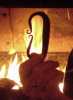 In this class we will make a fire-steel from high-carbon steel and learn to use it.
Techniques used will be drawing-out, bending, hardening, and tempering.
When the fire-steel is made we will learn to strike a spark with it and
turn that spark into a fire. We will also go over the particulars of
making char-cloth for catching the spark.
When the class is done you will have made a fire-steel, learned to make
char cloth, and struck a fire. You will come away with your own
fire-making kit consisting of a fire-steel, a flint, a char-tin
& charcloth, and a bit of tinder, enough to get started.
To bring if you can:
- a small metal box (like an Altoids tin) with a metal lid that fits fairly snugly, empty
- ~1 square foot or more of clean, old, worn, 100% cotton cloth to make into char-cloth
- a pouch or other container to hold your fire-kit, something you can fit both fists into should be the right size
There will be a modest (under $10) materials fee for flint and char-boxes for those who don't bring their own.
3.5 hours one session. Fee: $140
Full Description, Dates, and Registration Information.
Back to TOP
Fitchburg Forge-In
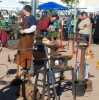 This is a chance to watch a number of smiths at many levels of skill working hard and fast to beat the clock AND each other.
There will be three competitive sessions where the smiths will have to complete projects in 1, 1, and 2 hours respectively. More info at the Fitchburg Forge-In website.
With competitive categories for beginner, intermediate, and advanced smiths, no entrance fee, and cash prizes, this is a fun event to compete in. Come out and cheer us on, or even better, bring your gear and compete.
In addition to the blacksmithing competition, there will be artisans, antique dealers, and a pumpkin carving competition. Free! Bring your friends! All of them.
Full Description, Dates, and Registration Information.
Back to TOP
Fitchburg Forge-In Practice
 We'll work on and talk about approaches to the projects at the upcoming Fitchburg Forge-In.
A couple of Timed Sessions will probably happen.
Roughly 3 hours Fee: Unclear, we'll talk. Like Open Smithy maybe?
Full Description, Dates, and Registration Information.
Back to TOP
Fixing Day
 We're going to take some time to work on the Bin of Broken Tools.
We'll be re-wedging and re-handling hammers, re-dressing punches and chisels, de-rusting, repairing, repurposing, tweaking, fiddling, and fettling as needed.
If you know what you're doing, great, we need you.
If you don't know what you're doing, great, we'll fix that too, but we are looking for some amount of smithing ability walking in (see the pre-requisite below).
Session length is variable, see the dates below. There is no fee. If you want to bring (gluten-free) noshes, that's cool.
Full Description, Dates, and Registration Information.
Back to TOP
Fold-Forming I Introduction
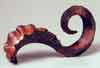 We will introduce Mr. Lewton-Brain's methods of working sheet metal by folding, deforming, and unfolding. There will be demonstration and hands-on work, mostly in copper, which will provide a quick overview of the range of form-folding techniques.
This class is a prerequisite to our Fold-Forming II class which is specifically for blacksmiths about fold-forming iron.
More information on fold forming can be found at: http://www.brainpress.com/Foldforming.html
There is Special Open Smithy time scheduled after the Fold-Forming II classes for those who wish to continue working out ideas and techniques while they're still fresh. If there is room, Fold-Forming I students will be welcome also.
3 hours 1 meeting $85
Full Description, Dates, and Registration Information.
Back to TOP
Fold-Forming II: Fold-Forming for Blacksmiths
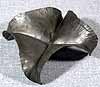 This class will focus on the basic fold-forming concept of working sheet metal by folding, working, and unfolding and its application to hot iron.
We will work on a few basic folds and the tools and techniques necessary for fold-forming in hot metal, and advance as time and abilities allow.
More information on fold forming can be found at: http://www.brainpress.com/Foldforming.html
There is Open Smithy time scheduled after the class for those that wish to stay and keep working on their pieces.
6 hours 2 meetings $250
Full Description, Dates, and Registration Information.
Back to TOP
Forge Welding Practice
We'll be refreshing the basic concepts of forge welding, then trying various types of weld as time allows.
2 hours, one meeting Fee: $35
Full Description, Dates, and Registration Information.
Back to TOP
Forge-to-Go
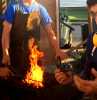 We bring one or more of our mobile smithing set-ups, all materials and safety gear to your place and set up outside.
(We have a decent fly for cover in the event of rain or excessive sun)
We can arrange to do any of our usual classes, from A Taste of Blacksmithing to The DIY Off-the-Grid Guerilla Patternwelded Billet or a class/lesson/session to suit the student(s) needs, interests, and abilities.
With one forge we can accommodate one or two students who are from the same epidemiologic bubble/pod/unit. It is possible to bring an additional forge for additional students who can be from a different bubble (see below).
Most aspects of this experience are negotiable.
The listings below (if any) have only one space in them here on-screen. That's for the person who's organizing the class, all the details; start time, number of students, project, address, payment... will be handled by phone or text.
If a date listed below works for you (and your group) sign up for it and we'll work it out. We'll get it done so long as the weather isn't truly horrible.
If you'd like to discuss scheduling a Forge-to-Go session some time/day other than those listed below, please call Carl at 781 81oxide (781 816 9433) after 10am.
Calling is best, emails and texts often get lost in the flood.
Class length is negotiable, but typically 3 hours $100 base fee + $100/hr, 2 hours minimum
Additional forges $75 each
Travel more than an hour from Waltham will be a bit extra
Full Description, Dates, and Registration Information.
Back to TOP
A Forged Iron Bottle Opener
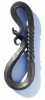 This bottle opener is an excellent first project.
The student is introduced to the blacksmith's techniques of flattening, bending, hot-cutting, drawing-out to a taper, chamfering, more bending, and twisting (in that order).
This class also serves as a pre-requisite for classes that have "A Taste of Blacksmithing" as a pre-requisite.
In the end, the student can reasonably expect to have a pleasantly hefty handful of bottle-opening wonderfulness.
If you have a Gift Certificate for this class but none of these dates work for you, have a look at our A Taste of Blacksmithing class.
The skills taught are near-identical to those in this class, and we will happily apply a Bottle Opener Gift Certificate to the Taste class.
If you really enjoy this class, there is more you can do afterward.
4 hours, one meeting... It's not unusual for it to run long. Tuition: $85
Full Description, Dates, and Registration Information.
Back to TOP
Forging A Forging Hammer
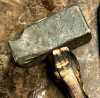 In four three-hour sessions, students will forge and finish their own 2lb forging hammers, as well as the tools to make them.
Students will learn the basics of striking (teamwork with a sledgehammer) and forge their hammers and hammer eye punches through the power of friendship.
Afterwards, students will grind, harden, differentially-temper, and handle their hammers for use as they continue their smithing journey.
four three-hour sessions Tuition: $405
Full Description, Dates, and Registration Information.
Back to TOP
Forging Aluminum (cold) for the Young and the Interested
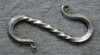 Working cold aluminum is a lot like working hot iron, but without the danger of learning what burning human flesh smells like.
In this class we will introduce the student (age eight or older) to the basic smithing techniques of hammering, drawing-out, cutting, bending, and twisting. Using these techniques and a piece of aluminum, you and your child will create decorative and useful 'S'-hooks (one each!) with anvil, hammer, and tongs. Some students may instead be guided through the making of a J-Hook.
Working cold aluminum is a lot like working hot iron, but without the danger of learning what burning human flesh smells like.
In this class we will introduce the student (age eight or older) to the basic smithing techniques of hammering, drawing-out, cutting, bending, and twisting. Using these techniques and a piece of aluminum, you and your child will create decorative and useful 'S'-hooks (one each!) with anvil, hammer, and tongs. Some students may instead be guided through the making of a J-Hook.
This class is not limited to youngsters (a parent or guardian is required for those under ten). The material presented is similar to that in our "A Tween's First Taste of Blacksmithing" classes, but without the heat.
Enrollment is limited to four students, so that they don't have to share tools and workspace. This class is offered at a variety of times of day and week to suit the schedules of un-schoolers, home-schoolers, and conventional-schoolers.
one meeting, 2 hours. (no longer offered)
Full Description, Dates, and Registration Information.
Back to TOP
Garrison House
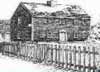 We'll be demonstrating traditional blacksmithing techniques at the Colonial Crafts Day in Chelmsford MA. $3/person, or $5/family
Full Description, Dates, and Registration Information.
Back to TOP
A Gift Season Event at Prospect Hill Forge with Tail in the Mud Pottery
 We may demonstrate some of the wonders of blacksmithing. There will probably be some clay on the wheel at Tail in the Mud Pottery in the other end of the building.
We will convert forge 3 to a grill by charging it with charcoal instead of coal (feel free to bring things to cook on a stick or grill [but please no raw chicken or pork]),
and we plan to mull cider properly... with mullers and loggerheads.
Unlike most barbecues, weather doesn't change our plans, we are set up to do it indoors.
There will be tables of ironwork and pottery for sale but there will be no high-pressure sales talk; it's a party and we're here to enjoy it too.
But hey, if you ask about taking classes or learning about blacksmithing or pottery...
Directions to the smithy.
Usually a full afternoon or a full evening No admission fee, but feel free to bring something to throw on the grill, or cook on a fork.
Full Description, Dates, and Registration Information.
Back to TOP
Glass Friday at Diablo Glass
 We'll be taking an evening away from the forge to go play with hot glass in the Hot Shop.
We think it'd be way cool if we showed up with a bunch of blacksmiths all at once.
So, if you're interested, use this link and sign up to come with us on Friday Jan 28.
3-4 hours at their place $95 (pay them, not us)
Full Description, Dates, and Registration Information.
Back to TOP
Gore Place Sheepshearing Festival
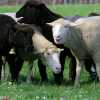 A demonstration in Waltham on an historic site.
The mansion at Gore Place was built in 1806, set on a 45 acre house lot with surrounding farmlands. The Gores entertained such notable dignitaries as Daniel Webster and James Monroe in their beautiful home, “outfitted for all seasons.”
We will be demonstrating blacksmithing in relatively period manner (it's only changes so much in the last 4000 years) through the day. There're lots of other things nearly as interesting as blacksmithing going on also.
[Click for more info about the festival (directions for example)]
7 hours $20 entry fee over 12 years old (pay them, not us)
Full Description, Dates, and Registration Information.
Back to TOP
Guided Open Smithy
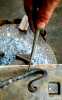 This is a time to work on your own projects with an experienced smith at hand to help work out ideas, techniques, and approaches.
The experienced smith may be working on something of their own during this session, but their priority is to be there for you. Feel free to interrupt them at any time.
3 hours Fee: $95 for the first three hours, $50/hr in 15 minute units to run over time
Full Description, Dates, and Registration Information.
Back to TOP
Hammer Skills
Hammer Skills
The class is equally suitable for young teens, pre-teens, and
adults and older teens that need practice to improve their hammer skills.
The class focuses on hammer technique, drawing out, twisting, and
bending. In particular, the student will learn to deliver power, improve hand/eye coordination, and deliver controlled strikes with the hammer, creating a smooth surface on the piece being worked. Arm-strength and stamina will also improve. On the mental side of things, patience, preparation, and attentiveness will be practiced.
Its intent is to develop these basic skills sufficiently to prepare the student to work on our standard Rudiments material, whether in the regular adult evening course or the after-school or summer teen programs.
For adults, Hammer Skills can serve as a remedial class for those who had some difficulties in "A Taste" or "Rudiments", and want to practice a bit before continuing. A Taste of Blacksmithing remains the recommended intro class.
For teens, Hammer Skills can serve as a substitute for "A Taste", or go between "A Taste" and "Rudiments" to build up hammer skills, or while waiting for a section of Rudiments to open up.
For pre-teens, Hammer Skills is the only class we currently offer.
The class runs through a series of simple projects, mostly
different types of hooks, though the occasional plant-stake or skewer may show up. All the projects will have roughly the same level of difficulty and use a similar set of techniques, so that students can attend the class whenever convenient. The purpose is to work on strengthening a small variety of important basic techniques, rather than covering a lot of different skills.
The projects will vary somewhat to maintain interest and to suit the individual student, but have enough similarity allow the student to develop some familiarity with the processes and vocabulary, and also make it easy to see their progress.
Some section of Hammer Skills will run afternoons, presently scheduled for 1:30 - 4:00, with a snack break partway through (bring your own snack!)
The cost per week will be $85, and class can be registered for on a week by week basis, or by the month. There will be a slight discount for one-month packages ($320/month).
Broadly speaking, this class will eventually prepare the student to
take our regular Rudiments series classes or, for the student who had
trouble with Rudiments I, help them prepare for Rudiments II.
2.5 hours, variable number of meetings $85 per week, or $320/month.
Full Description, Dates, and Registration Information.
Back to TOP
A Hatchet in the Viking Style
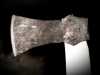 We'll be making a light wrap-around hatchet with a Viking-ish feel to it (We will be drawing out cusps on the cheeks of the eye). The body of the tool will be mild steel bent around the eye and forge welded together. A spring steel edge will be welded in so that the tool's edge can be hardened and tempered.
The finished head will be around 8oz.
This same recipe and collection of techniques, once the student has a handle on them, can be used to make ax or hatchet heads of any size the forge will get hot enough.
Techniques:
Drawing-out, shouldering, spreading, measuring, bending, *welding*, heat-treating, sharpening.
It's not expected that we will get all the way to hanging (putting the handle in) the hatchet, but there will certainly be discussion of the process.
9 hours in three 3 hour meetings Tuition: $375
Full Description, Dates, and Registration Information.
Back to TOP
Heart-Shaped Trivet
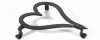 This class covers the production of a traditional and useful heart-shaped trivet, based on several in the Sorber collection of colonial wrought iron.
Make one for your sweetheart for Valentine's Day (or commission us to make one for you!)
6 hours, 2 3-hour sessions. $210
Full Description, Dates, and Registration Information.
Back to TOP
Heat Treating
 A discussion about what's-going-on-with-the-atoms-in-there when annealing, normalizing,hardening, and tempering steel. A bunch of why and a fair bit of how, and a chance to play with it for a bit. With lots of time for questions.
One meeting, 2 hours Fee: $35
Full Description, Dates, and Registration Information.
Back to TOP
Help Carl Move
 Carl has to pack up after living just up the hill from the Smithy for the last nine years.
If you’ve been a student at Prospect Hill Forge and you can spare a couple hours during this time, your help and company will be greatly appreciated.
Please call the forge number ahead to make arrangements and get the address.
I currently have cookies and brownies (gf and not) and soda laid in… and good food establishments nearby.No fee
Full Description, Dates, and Registration Information.
Back to TOP
I Sebastiani Performance
 Commedia dell'Arte is the ancestor of every sitcom you've ever seen.
Stock characters in different situations: the rich man, the learned man, the lovers, the helpful servants, the overhelpful servants, the self-serving servants, the thief, the braggart...
We perform without a script, instead we have a scenario (the outline of the story with entrances and exits).
We practice until we have it (fairly) straight in our heads, then we perform it for you.
Our shows are typically family-friendly, our humor is broad-spectrum - from low to high, childish to mature, churlish to scholarly... we do our best to fly the innuendo over the 12-year-olds' heads.
More information and a brief video Click Here.
Mike is a founding member of the troupe, Carl has only been doing it since '97.
The shows are typically about an hour long. Usually three acts with musical intermezzi. Admission varies with the venue, usually we ask a donation and/or pass the hat at the end.
Full Description, Dates, and Registration Information.
Back to TOP
Innovations of Yesteryear
 We'll be participating in the Innovations of Yesteryear festival along with various other artisans, entertainers, and educators. Come visit!
Click for more Information about the museum and the festival.$10.00 admission gets you into both the Festival and the Museum.
Full Description, Dates, and Registration Information.
Back to TOP
International Steampunk City
We will be smithing on Waltham Common. There is no admission fee
Full Description, Dates, and Registration Information.
Back to TOP
Iron Carving
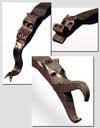 You'll learn how to use punches and chisels to open mouths, punch noses and eyes, and cut ears and horns to make fantastical creature heads with unique personalities.
6 hours 2 meetings $250
Full Description, Dates, and Registration Information.
Back to TOP
Keep on Smithin'
 This course builds on what you have learned so far so that you can keep on smithing. In these classes you will further refine your skills at the forge and anvil... according to the needs of the group.
3 hour meetings, 2 or 4 meetings Tuition: $390/ four weeks, $200/ two weeks
Full Description, Dates, and Registration Information.
Back to TOP
Knives, Knives, and More Knives
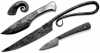 You've already made a simple blacksmith knife.
We'll be making knives with rat-tail handles, whittle-tang knives with wooden handles, knives with wooden slab handles. Knives made from automotive coil spring, knives made from bed-rail, knives made from strapping steel, knives made from saw blades. Utility knives, cooking knives, nut choppers, craft knives, necklace knives, camping knives... You get the picture, lots of knives in as many ways as we have time for.
To some degree, the choice of knives made will be influenced by the class' desires, but the instructor reserves the right to stipulate the occasional "learning experience".
8 meeting three hours each $910
Full Description, Dates, and Registration Information.
Back to TOP
Learning to Make a Chef's Knife
 This class is particularly for professional cooks who'd like to develop the skills necessary to make their own knives.
We'll be starting with no blacksmithing skills, and aiming the practice toward the skills needed to produce a reasonable-length cooking knife with a full-tang, pinned wooden slab handle.
In the first few meetings, we'll work on basic skills; fire lighting and tending, swinging the hammer effectively, and developing a sense of how the metal flows under the hammer.
When it comes to the making of the knife, we'll be upcycling readily available high-carbon steel, cutting out the rough shape with an abrasive saw, forging the tapers for the point and the edge, filing and grinding the blade, drilling the tang and slabs, hardening, differential-tempering, assembling and gluing-up the handle, shaping the handle, and sharpening.
6 three-hour meetings Tuition: $590
Full Description, Dates, and Registration Information.
Back to TOP
Leather Sheathmaking -- An Introduction
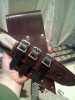 Guest instructor Jessica Reynolds is a professional leatherworker and sheath maker at the New York Renaissance Fair. She'll introduce you to the tools of the trade, how to measure, cut and sew your custom sheath, and some quick tips on shortcuts.
In the first session of this class, Jessica will demonstrate one, possibly two methods of making sheaths and lead you through the process of making a custom sheath to fit your own knife. Don't forget to bring your knife with you! In the second session, you can complete your sheath or, if you've been zipping along, make a second sheath under Jessica's supervision.
There will be an (as yet to be determined) materials fee for this class.
Toolkits (optional) will also be available for those who wish to continue making sheaths at home.
6 hours, 2 meetings. Tuition: $145.00
Full Description, Dates, and Registration Information.
Back to TOP
Letter Openers
In this class we will use the tools of the blacksmith to make one or more letter openers. We will use many of the techniques used by knifesmiths and forge a piece of mild steel into a blade and handle, but unlike a knifesmith, we will not concern ourselves with hardening and tempering the blade.
While not required, this class is an excellent precursor to any of our knife classes.
6 hours in two meetings $210
Full Description, Dates, and Registration Information.
Back to TOP
Liberty and Union Festival in Taunton, MA
 We'll be demonstrating Blacksmithing with a Colonial American emphasis.
There will be tables of smithed items for sale or conversation.
And there'll be a bunch of other stuff going on... Check it out at:
https://www.libertyandunion.org
The fair runs from 11 am to 4pm There is no admission price, it is a free event.
Full Description, Dates, and Registration Information.
Back to TOP
Make a Tomahawk from a Railroad Spike!
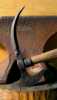 In this class you'll start with a plain or garden-variety Railroad Spike, and end up with a small hand-axe that's anything but plain. You'll learn how to forge a small axe-blade, get in some more practice punching and drifting eyes, and split, carve, and install a handle in the process.
Emphasis will be on making a striking and attractive pseudo-weapon.
When you're done with this class, you'll be fully prepared to deal with the Zombie Apocalypse, especially if it takes place while you're cruising Boston Harbor in the Queen Anne's Revenge. While you're waiting for that, your new 'hawk will come in handy for splitting kindling.
Three 3-hour sessions. Tuition: $375
Full Description, Dates, and Registration Information.
Back to TOP
A Makeup Class
 Sometimes a student has to miss a class-meeting and we do our best to find a mutually convenient time to keep the student in step with the class.
The usual fee for the first makeup in a multi-meeting class is GOOD baked goods or GOOD alcohol, keeping in mind that it's 3 hours of the instructor's time. Questions about what "GOOD" means are welcome.
Typically three hours in a single session Class tuition to be determined.
Full Description, Dates, and Registration Information.
Back to TOP
Making Blacksmith Tools
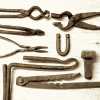 We'll be making tongs of several sorts (but not the rivets, we'll do that the easier way), we may make a medium-sized hammer (maybe convert a ballpein to a crosspein), some punches and chisels, a bending 'U' with the notches for diagonal bending, a box-joint plier, a bottom-tool blank/anvil block, a bick-iron, at least one kind of cutting hardy, a spring fuller... many of the tools you are used to finding on (or somewhere near) the bench at PHF.
Exact content of the class is somewhat up to the class members. The focus will be on the mental tools (techniques and approaches to answering your tool needs) more than actually making every physical tool you need.
Some of the tools will require the class to get together and do some gang-hammering Striker-Team-style.
12 meetings at least, 3 hours each Fee: $1200
Full Description, Dates, and Registration Information.
Back to TOP
Making Bloomery Iron
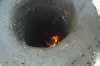 This is more a participatory demo than a class per se. We expect it to take all day. If it rains, we'll be doing it indoors at the smithy. If the weather is nice, we'll be doing it outdoors, a little further out in the suburbs, at a location TBA.
In the first few hours we will mix up some "cob" (dirt/sand/clay/loam and straw) and build a small bloomery-furnace.
We will then fire it with charcoal and over the next few hours we will add ore (magnetite) and charcoal until we believe we have a sufficient iron "bloom" in the bottom of the furnace. Then we will open it and commence to consolidate the bloom into a 'muck bar' and possibly continue on to wrought iron if time/energy/interest allows.
Through the day there will be continuous opportunity to just watch.
In the morning there will be a chance to play grassy-mudpies while we build the furnace; after that everyone can take a turn on the hand-cranked blower (or the bellows if we get ourselves together to do it really old-style). At the end, there will be some opportunity for striker-team folk to help consolidate the bloom.
There will be ample schmoozing time during the process. Food will be acquired as needed, by whatever means seem appropriate at the time, and we will go until we are done. You needn't come-at-the-beginning-and-stay-to the-bitter-end (unless of course you want to). Dropping in and out through the day as fits your schedule and interest is just fine.
School trips and the like are welcome; check in with us about when will be the best time to come by to suit your objectives.
One meeting, roughly 12 hours Fee: $25 before lunch, $25 after lunch, bring something to share for lunch, and lunch time is free. Lunch will probably be around 2pm
Full Description, Dates, and Registration Information.
Back to TOP
Making Your Mark
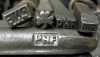 We will approach the punch-making process from a few directions:
- Carving the design directly on the end of a punch (un-framed punch)
- Carving/punching the design into the end of a punch (framed punch)
- Carving the design to punch in the end of another punch (a master for a framed punch)
We'll cover theory, filing, sawing, counterpunching, super-quenching, annealing, hardening and tempering, and the tools necessary.
And maybe a bit of type design, as needed.
If you have a binocular magnifier or a pair (or two) of strong reading glasses, bring them.
(Ocean State Job Lot has them pretty cheap, go for the +3 diopter ones)
Total 9 hours in three three-hour meetings Fee: $375
Full Description, Dates, and Registration Information.
Back to TOP
Making Your Own Thread
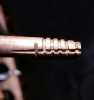 We'll be hand-carving a tap
to make a die
to make a tap
to make a die
to make a tap
By which step the tap and die should be usable for making functional items like nuts and bolts, clamps, hand-vises...
There will be lots of filing and heat-treating.
And a bit of hammering. These things will need handles.
Note: the threads we make will be utterly personal. Non-standard in nearly every way.
It is currently unclear whether we will continue on and make a c-clamp with our new taps and dies.
Length unknown at this time Fee: also unknown at this time
Full Description, Dates, and Registration Information.
Back to TOP
Making a Warhammer
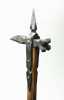 A pointy thumpy bit to put on the end of a stick.
four 3 hour meetings Tuition: $390
Full Description, Dates, and Registration Information.
Back to TOP
Maple Sugar Days
 We'll be demonstrating smithing amongst maple sugarers and post-and-beam builders in Milton MA.
"Maple Sugar Days is a joint program of the Department of Conservation and Recreation and Massachusetts Audubon’s Trailside Museum."
for More Info Click here.
Directions:
Brookwood Farm is located in the DCR Blue Hills Reservation in Milton. Take Exit 3 (Houghton’s Pond) off Route 93 and follow signs to Maple Sugar Days parking.
6 hours on each of two days There is a $6 admission fee. Pay them, not us. It benefits theTrailside Museum.
Full Description, Dates, and Registration Information.
Back to TOP
Medieval Knife Camp
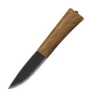 The whittle tang is a fairly quick, easy, and medieval way to hold a handle onto a knife.
We'll be making a practical*, small-bladed utility/eating knife, starting with a piece of automotive coil spring and a chunk of a tree.
We'll forge the tang, then the blade, file to shape and heat treat the blade. Then we'll install and finish the handle, and if time allows, we will make a leather sheath.
If you have wood (or antler, or bone) that you want to use as the handle, bringing it to the first meeting would be helpful.
*Please check any fantasies about making a "... THIS is a Knoife!" at the door. Our goal is to make a knife with a 3" blade.
15 hours in five meetings Tuition: $490
Full Description, Dates, and Registration Information.
Back to TOP
Metal Roses, Copper and Steel
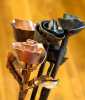 This class will use the familiar rose shape as an introduction to smithing skills and tools.
The first half of the class will be an introduction to various common tools and techniques used in shaping metal as you use a hammer and anvil to draw, flatten, taper, and bend copper into a rose you can take home.
Once you've had the opportunity to practice these moves, the second half of the class will focus on applying these techniques to a harder metal, still using traditional tools and techniques but this time with hot steel.
At the end of the second half you will have a second rose, maybe more, made out of steel, to bring home.
6 hours, one meeting (with lunchbreak) Tuition: $250
Full Description, Dates, and Registration Information.
Back to TOP
Middlesex 4H Fair in Westford Massachusetts
 PHF will be demonstrating, but not selling anything, from no later than 10am (and maybe earlier) until 4:30.
At least 6 hours, maybe more. Admission to the fair is $7 or less
Full Description, Dates, and Registration Information.
Back to TOP
Middlesex County 4H Fair in Westford MA
 We'll be demonstrating blacksmithing, touting our classes, showing off things we've made both in class and extracurricularly, and offering them for sale!
There will be lots of other activities, many animals... lots of... 4H stuff.
Click for more info on the Fair
Most of the day There's admission fee to the site, check their website.
Full Description, Dates, and Registration Information.
Back to TOP
Mike's Birthday
This'll be a party in the evening, at the forge, celebrating the fact that Mike gets to tick-off another year. It's not a surprise. We'll probably do a bit like we do for an Open House, that is: we'll have a forge set up for grilling over charcoal, a table for snacks, a table for beverages, and a fairly freshly swept floor.
This'll go for several hours Bring your presence.
Full Description, Dates, and Registration Information.
Back to TOP
NEMES Annual Show -- New England Model Engineering Society
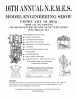 A meeting and show at which the members of the Society show off their latest works.
http://www.neme-s.org/
Members of NEMES will fill the Jackson Room at the CRMII with all sorts of interesting gadgets.
Free with Museum admission.
Full Description, Dates, and Registration Information.
Back to TOP
Nailmaking
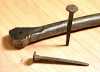 We will make a nail header and then use it to make hand-wrought nails.
The cost of the class includes 3 hours of Open Smithy (at a discounted rate) for the continued making of nails.
Techniques: drawing, hardening, tempering, upsetting, punching, cutting, heading nails.
One session, 3 hours Fee: $190
Full Description, Dates, and Registration Information.
Back to TOP
New England Blacksmiths
The semi-annual meeting of the New England Blacksmiths.
More info at:
http://www.newenglandblacksmiths.org/spring_&_fall_meets.htm$26 (pay them)
Full Description, Dates, and Registration Information.
Back to TOP
New England Blacksmiths - Fall Meet
 The semi-annual meeting of the New England Blacksmiths.
More info at:
The semi-annual meeting of the New England Blacksmiths.
More info at:
http://www.newenglandblacksmiths.org/spring_&_fall_meets.htm$75 (pay them)Click here for the registration form
Full Description, Dates, and Registration Information.
Back to TOP
New England Blacksmiths - Spring Meet
 The semi-annual meeting of the New England Blacksmiths.
More info at:
The semi-annual meeting of the New England Blacksmiths.
More info at:
www.newenglandblacksmiths.orgFee unclear, bring some money, there's food, and tools and stuff to learn.
Full Description, Dates, and Registration Information.
Back to TOP
The New England Folk Festival
 PHF staff will be at NEFFA for the three days of the event, participating as staff and dancers, probably not demonstrating blacksmithing.
3 days Check their site for admission fees
Full Description, Dates, and Registration Information.
Back to TOP
Nothing but Knives
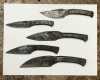 In this class the student will start by learning the basic moves of
knife-making on a piece of mild steel, ending up with a letter-opener
if all goes well, and then move on to a piece of high-carbon spring
steel and make a small, simple, one piece knife, suitable for cooking,
eating, or general use.
In this class the student will start by learning the basic moves of
knife-making on a piece of mild steel, ending up with a letter-opener
if all goes well, and then move on to a piece of high-carbon spring
steel and make a small, simple, one piece knife, suitable for cooking,
eating, or general use.
Focus will be entirely on making a knife; only those tools,
techniques and concepts needed for knife making will be addressed. The
fires will be managed by the instructor.
Techniques include: straightening, drawing out, forging high-carbon
steel, flattening, shouldering, pre-allocation of bend and mass, beveling, annealing, filing, hardening,
tempering, and sharpening.
9 hours in three 3 hour meetings $375
Full Description, Dates, and Registration Information.
Back to TOP
OS Monitor Meet
A chance to get together, refresh ourselves and our memories as to what's where, and how stuff works. Some things have changed.
Maybe we light up and fix some tongs, dinner after is an option.
We'll figure it out.
If we do pizza from up the street we'll need to order early. Or maybe get some from Waltham Pizza in less of a hurry. Waddaya want on it?
an evening, Class tuition to be determined.
Full Description, Dates, and Registration Information.
Back to TOP
The OS Monitors' Private List
Add yourself to the Notification List to get emails about Open Smithys that are available/need monitoring, fixing days, thankyou parties...
This is an experiment.
- Carl West, Blacksmith
Three hours at a time for the rest of your functional life. No Fee
Full Description, Dates, and Registration Information.
Back to TOP
Open House at Prospect Hill Forge
 We may demonstrate some of the wonders of blacksmithing. We usually convert one or two of our forges to grills by charging them with charcoal instead of coal (bring things to cook on a stick or grill), and mull cider with mullers and loggerheads. Unlike most barbecues, weather doesn't change our plans, we are set up to do it indoors.
If you like, you can sign up for blacksmithing classes, or buy ironwork or gift certificates while you're here.
There will be no high-pressure sales talk; it's a party and we're here to enjoy it too. But hey, if you ask about taking classes or learning about blacksmithing...
Directions to the smithy.
Usually a full afternoon or a full evening No admission fee, but feel free to bring something to throw on the grill, or cook on a fork.
Full Description, Dates, and Registration Information.
Back to TOP
Open Smithy
 This is a chance to use your blacksmithing knowledge to work on your own projects or continue on a project begun in a class.
You are expected to have some idea about what you are doing (including cleaning the forge, lighting it, and putting it out), this is not a teaching situation.
There will be a monitor whose job it is to help keep you and the tools safe, and to know where stuff is, but the monitor is not expected to be any more helpful than that, it sometimes happens, but it's not to be expected.
If you would like to reserve a forge in a scheduled Open Smithy session, please scroll down to the date that interests you and click where it says "Click Here".
NEW:
If you are not utterly certain about your approach to your project, consider coming for a Guided Open Smithy session to get an experienced smith's opinion and guidance.
Note: We have stock for purchase, we have some 3/8"square scrap bits for practice, or you can bring your own.
Further Note: No plated or galvanized material is to be put in forges at Prospect Hill Forge.
Also Note:
If you just show up or wait until the last minute to sign up, you're taking a chance that no one else reserved and no monitor signed up, OR that lots of people reserved and there's no room for you.
Hours vary. See below. $25 per hour 1 hr minimum 10%-off 10-hour-package discount available ($225) (+$10 cash for the forge-fire lesson if needed)
Full Description, Dates, and Registration Information.
Back to TOP
Our Fourteen-and-a-halfth Birthday
 November 1 is Prospect Hill Forge's half-birthday.
It's been over a year and a half since we've had a party, and 14 and a half years since we started this blacksmithing craziness ... we're still going strong (modulo pandemic) and we'd like to celebrate.
This will happen in the space we've been using for our Outdoor Classes at 58 Guinan Street, just up the street from the smithy you're used to. (there will be signs)
We'll be using one-or more of our portable forges to grill on, there'll be a portable loading dock for drinks and nibbles.
We'll start around 1pm to take advantage of the daylight, and run as late as 7pm (with lights)
As I write this I have no sense of what the weather might hold for that day, I'm being optimistic. Dress for the weather, we have canopies if necessary. - CW
Don't come if you're not vaccinated, we still have unvaccinated youngsters in our bubble. Feel free to maintain distance.
Roughly 6 hours Feel free to bring something to go on the grill, or on the Loading Dock
Full Description, Dates, and Registration Information.
Back to TOP
Our Fourth Birthday Party
 We opened officially on May 1st, 2007, but our Grand Opening Bash was later in the month, so it seems fitting that our Birthday Party should be a bit late, too. The evening of Saturday, the 14th of May, fits that bill beautifully.
We'll have one of the forges charged with charcoal so that we can cook over it. (Food cooked over coal is not a tasty treat.)
So, mark your calendars to drop by the smithy to have a schmooze, a beverage, and a nibble. As with any Open house, if you've completed Basics or Rudiments III you can come in and play on our dime to the amusement and edification of the other attendees.
Saturday evening from ~6 until fairly late No charge, but feel free to bring party supplies -- and friends!
Full Description, Dates, and Registration Information.
Back to TOP
Our Nineteenth Birthday!
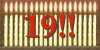 NINETEEN YEARS!
Holy Cow What a trip!
Over 5000 students have come through, and we're not done.
NINETEEN YEARS!
Holy Cow What a trip!
Over 5000 students have come through, and we're not done.
We're celebrating. It'll be the usual schmoozy Open House sort of thing; charcoal in forge three so we can grill (many things, Gonna try to remember the PEEPS!), chips, dips, other party snacks, beverages, interesting company...
Yeah, this went up with very short notice, but...
Next year is our 20th birthday and I want to DO something with that,
and May 1st is on a Saturday in 2027, so put it on your calendar now for next year, eh?
From 5pm to 9pm There is no cash fee, or tuition. If you bring something for the table or the grill (please no raw pork or chicken), that'd be great, but your presence is all that is required.
Full Description, Dates, and Registration Information.
Back to TOP
Our Ninth Birthday
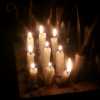 We started in May of '07, and it's been uphill ever since.
Well over a thousand students have experienced the thrill of imposing their will on incandescent steel since then.
It'll be pretty much the usual semi-pot-luck, we'll trick out forge 3 with a grill and charcoal for tasty cooking of tasty things.
Please feel free to bring something to put on the grill, on the table, or in a cup.
Gluten-free items are especially appreciated.
We'll start about 4 and go until... 10-ish ... however long we maintain critical mass.
If you'd like to feel that there's a theme to the party... let's go with "the opposite of Nine" and do with that concept what you will.
This is intended to be a party more than anything else, if you want to talk about classes, or buy something, we will accommodate you, but we're not going to start anything.
roughly 6 hours Bring something good (see above)
Full Description, Dates, and Registration Information.
Back to TOP
Our Second Birthday Party -- (and Open House)
 We opened officially on May first 2007 but our Grand Opening Bash was later in the month, so it seems fitting that our Birthday Party should be a bit late too and the evening of Saturday the 16th of May fits that bill beautifully.
We'll have one of the forges charged with charcoal so that we can cook over it. (Food cooked over coal is not a tasty treat.)
So, mark your calendars to c'mon by the smithy have a schmooze, a beverage, and a nibble. As with any Open house, if you've completed Basics or Rudiments III you can come in and play on our dime.
Saturday evening from ~6 until fairly late Feel free to bring something to eat, drink, or cook, but it's not required.
Full Description, Dates, and Registration Information.
Back to TOP
Our Seventeenth Birthday!
 Seventeen Years!
We're celebrating. It'll be the usual schmoozy Open House sort of thing; charcoal in forge three so we can grill (many things, Gonna try to remember the PEEPS!), chips, dips, other party snacks, beverages, interesting company...
Check this space again as the date draws near in case there are changes.
There is no cash fee, or tuition. If you bring something for the table or the grill, that'd be great, but your presence is all that is required.
Full Description, Dates, and Registration Information.
Back to TOP
Our Seventh Birthday
 Seven Years.
Wholely Moley.
We started in May of '07, and it's been uphill ever since.
We've had nearly a thousand students in that time. Some have caught on fire, a few have merely burned themselves.
It'll be pretty much the usual semi-pot-luck, we'll trick out forge 3 with a grill and charcoal for tasty cooking of tasty things.
Please feel free to bring something to put on the grill, on the table, or in a cup.
Gluten-free items are especially appreciated.
We'll start about 6:30 and go until... midnight-ish ... however long we maintain critical mass.
If you'd like to feel that there's a theme to the party, consider it to be "Lucky Seven" and do with that concept what you will.
This is intended to be a party more than anything else, if you want to talk about classes, or buy something, we will accommodate you, but we're not going to start anything.
One meeting, roughly five and one half hours. There is no fee. Just bring Your Own Fine Self.
Full Description, Dates, and Registration Information.
Back to TOP
Outdoor Class
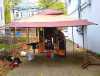 Our Outdoor Classes are our answer to trying to cope with the pandemic. With all participants vaccinated (proof required), we'll be outdoors and make an attempt at keeping distance whenever possible.
Actual content of each class is described below.
The class happens up the street from Prospect Hill Forge in the driveway of 58 Guinan Street.
Typically 3 hours Fee: $100 for one person or $170 for two sharing the same forge. (The two will sign-up in one student space on the form)
Full Description, Dates, and Registration Information.
Back to TOP
A Penannular Brooch
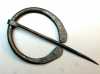 We'll make a penannular brooch identical in function to those that have been in use since, at latest, the Iron Age.
We'll file, bend, forge, draw-out to a point, flatten, cut, bend some more, on the way to making a simple form of this ancient fabric-fastening device.
You can use it to hold your kilt shut, your plaid in place, your cloak closed, anywhere you might wish to connect sturdy fabric to sturdy fabric.
"Where'd you get the brooch?"
"I forged it myself."
One 3 hour session. Fee: $100
Full Description, Dates, and Registration Information.
Back to TOP
The Pensic War
 Pensic is essentially the annual international convention of the Society for Creative Anachronism. If it's medieval and fun, we do it, and it all gets done at Pensic.
Western Pennsylvania, Here we come!Class tuition to be determined.
Full Description, Dates, and Registration Information.
Back to TOP
Preserving the Fire
 3 Days of Hot Metal at The Ashokan Center, Olivebridge, NY
A Cooperative Event, Sponsored by:
Northeast Blacksmiths Association,
New England Blacksmiths Association,
Blacksmith Guild of Central Maryland
With the Support of:
Connecticut Blacksmiths,
Capitol District Smiths,
Berkshire Blacksmiths,
Blacksmith's Guild of the Potomac,
Pennsylvania Artist Blacksmiths' Association
More information at http://acblacksmiths.org/Register before Aug 1st to avoid late fees.
Full Description, Dates, and Registration Information.
Back to TOP
Private Class
 A Private Class might be a special subject asked for by a group with a particular interest, it could be an advanced topic we don't usually offer, it could be a corporate team-building exercise...
It's hard to say which it is this time, these things have happened, and will happen again.
Note:If it says next to a date listing below, that no one has signed up for the class, all that means is that none of the participants have signed-in online. Possibly because it's a surprise.
Class length is negotiable. Fee: Negotiable
Full Description, Dates, and Registration Information.
Back to TOP
A Private Party at the Forge
 Prospect Hill Forge is happy to host your party, be it to celebrate an Engagement, an upcoming Marriage, an Anniversary, a Birthday, a Bar Mitzvah, a Reunion, a Bat Mitvah... any day that is so important you want to remember what you and your family or friends did that day for the rest of your life.
We've done corporate team-building exercises and Thank-God-That-Project-Is-Done celebrations.
We can tailor a class to your needs, interests, and (within the constraints of our already-scheduled classes) your schedule.
We hosted a Bridal Shower where the guests all made hooks to fit on the bride's Pot Rack. The bride is making the Pot Rack herself.
There was a young man's 13th Birthday Party where his friends got to beat on hot iron, and most of them made useful items.
We had a Bachelor Party where the groom's friends all took our 'Nothing but Knives' class together.
Surely there's an occasion in your life that ought to be marked by hammering hot iron.
Class length: Negotiable The fees for Private Parties are negotiated on a case-by-case basis.
Full Description, Dates, and Registration Information.
Back to TOP
RR Spike Bottle Opener
We'll start with an old railroad spike, and wind up with something that can open bottles, and is still recognizable as a RR spike. Intended for rail enthusiasts to have fun with some smithing, this class will involve twisting, drawing out, dishing, and the fiddly work of adjusting a bottle opener so that it works.
This class is NOT generally a substitute for "A Taste of Blacksmithing".
1 three-hour meeting Fee: $125
Full Description, Dates, and Registration Information.
Back to TOP
The Raised Vein Leaf
 The project for the class will be working through the raised-center-vein leaf motif we use at PHF for the dragon tail-fluke in Rudiments II. Time allowing we may turn it into a pendant or key-fob. The main skill used in this project is the setting of shoulders... setting material down and leaving material high.
We will be using Zoom as the group-meeting app.
Clicking the link above will tell you what you need to make it go on your device.
The Zoom meeting URL will be emailed out at least an hour before class and the meeting will be started 15 minutes before official class start so we can check the tech and maybe visit each other's smithies.
People on the standby list will have the option of auditing the class (see the fees below) but will be asked to turn off their cameras and microphones until the end of class (emergencies excepted).
The student must have: (please read this carefully)
- Their own blacksmithing set up:
- A forge, lit and running by the beginning of class, type is unimportant
(being able to back-down a gas forge while we're talking would likely be good, I don't know yet how much to trust noise-cancellation)
- An anvil-like object
- A hammer, 1 to 2 pound, no larger.
- Tongs to hold the stock
- Tongs to hold thin, flat material (the leaf)
- A cutting hardy or chisel
- A vise is nice especially if your anvil isn't a london pattern with the step.but not vital
- Eye and ear protection
- Ear buds or somesuch that fit under your ear protection so that you can hear me while you're hammering.
- A device that will run Zoom, has a camera, a microphone, and a decent 'net connection while in your work area.
- The ability to move that device around the work space so I can watch you work from helpful angles. A photographer's tripod and some way to hold your device on it would be marvelous
- Enough light. So both of us can see what you're doing
- If you're willing to give a brief tour of your set-up before class, that'd be cool.
Materials
At least 6" of 3/8" or 1/2" round or square steel, preferably mild.
If it's 18" or more long you won't need the stock-sized tongs.
2-ish hours Fees: Participating $50, Auditing - Free, come see how it works.
Full Description, Dates, and Registration Information.
Back to TOP
Ready, Set, Smith!
 A straight-through series of classes roughly equivalent to the usual PHF offerings of "A Taste of Blacksmithing", "Rudiments of Blacksmithing I", and "Rudiments II" all in one package.
Techniques that will be covered:
Shop Safety
Basic Hammer Technique
Fire Management
Drawing Out
Scrolling
Bending
Isolating Mass
Shouldering
Dishing
Punching and Drifting
Splitting
Forge Welding
Basic Tool and Tong Making
Sculptural Forging
27 hours of class in 9 meetings of 3 hours each Tuition: $825
Full Description, Dates, and Registration Information.
Back to TOP
Remote Private Class
We bring one of our mobile smithing set-ups, all materials and safety gear to your place and set up outside.
(We have a decent fly for cover in the event of rain or excessive sun)
We can arrange to do any of our usual classes, from A Taste of Blacksmithing to The DIY Off-the-Grid Guerilla Patternwelded Billet or a class/lesson/session to suit the student(s) needs, interests, and abilities.
With one forge we can accommodate one or two students who are from the same epidemiologic unit. It is possible to bring an additional forge for additional students (see below).
Most aspects of this experience are negotiable.
Class length is negotiable $100 base fee + $100/hr, 2 hours minimum
Additional forges $100
Full Description, Dates, and Registration Information.
Back to TOP
Rudiments of Blacksmithing I
 This class picks up where "A Taste of Blacksmithing" and "A Forged Iron Bottle Opener" leave off. You'll
learn more about shop safety and begin to work on forge-fire management, while being guided through projects that will begin to build your repertoire of basic blacksmithing techniques, including:
This class picks up where "A Taste of Blacksmithing" and "A Forged Iron Bottle Opener" leave off. You'll
learn more about shop safety and begin to work on forge-fire management, while being guided through projects that will begin to build your repertoire of basic blacksmithing techniques, including:
| drawing out
bending
cutting
twisting
upsetting |
| splitting
punching
drifting
riveting
anticipatory choreography |
| and using:
slitting chisel
top&bottom swage
monkey tool |
The projects in
Rudiments I are a barbecue fork and a pair of smithing tongs.
There will be time after the hammers are down for questions and further discussion.
Taking the classes Rudiments I, Rudiments II, and Rudiments III
is the equivalent of taking
The Basics of Blacksmithing class.
12 hours total in either four 3-hour sessions or five 2.5-hour sessions. Fee: $390; a $100 discount applies if signing up for three sequential Rudiments classes at once, total $1070.
Full Description, Dates, and Registration Information.
Back to TOP
Rudiments of Blacksmithing II
 This class builds on the skills developed in Rudiments
of Blacksmithing I. You'll refine your command of forge-fire management, improve other existing skills, especially forging, and be guided through projects that will expand your repertoire of basic blacksmithing techniques by introducing:
This class builds on the skills developed in Rudiments
of Blacksmithing I. You'll refine your command of forge-fire management, improve other existing skills, especially forging, and be guided through projects that will expand your repertoire of basic blacksmithing techniques by introducing:
|
upsetting
hot filing
hardening
tempering
sinking |
|
grinding
forging high carbon steel
adjusting tools
forge-welding
sharp angle bending |
Typical projects in
Rudiments II include animorphic heads, spoons, center-punches, chisels, and brackets.
As always there will be time after the hammers are down for questions and further discussion.
Taking the classes Rudiments I, Rudiments II, and Rudiments III
is the equivalent of taking
The Basics of Blacksmithing class.
12 hours total in either 4 3-hour sessions or 6 2-hour sessions. Fee: $390; a discount applies if signing up for three sequential Rudiments classes at once.
Full Description, Dates, and Registration Information.
Back to TOP
Rudiments of Blacksmithing III
 This class continues where Rudiments
of Blacksmithing II left off. You'll finally have some idea of how to manage a forge-fire, and get to practice doing so. While doing so, you'll produce matching scrolls and generally work on having more control over your work, and learn still more basic techniques, including:
This class continues where Rudiments
of Blacksmithing II left off. You'll finally have some idea of how to manage a forge-fire, and get to practice doing so. While doing so, you'll produce matching scrolls and generally work on having more control over your work, and learn still more basic techniques, including:
| scrollwork
collaring
forging pipe |
| threading (taps and dies)
sheet metal work
bending matching curves |
Typical projects in
Rudiments III include candlesticks and ornamental scrollwork.Taking the classes Rudiments I, Rudiments II, and Rudiments III
is the equivalent of taking
The Basics of Blacksmithing class.
12 hours total in either 4 3-hour sessions or 6 2-hour sessions. Fee: $390; a discount applies if signing up for three sequential Rudiments classes at once.
Full Description, Dates, and Registration Information.
Back to TOP
Rudiments of Blacksmithing IV
 Rudiments IV can be seen as the first four weeks of Basics II.
In Basics II (Rudiments 4,5,6) each meeting starts with lighting the fire and adding another link to the chain. Then we get on about the rest of the class.
We will cover:
- basics of identifying and learning to heat-treat unknown steel.
- making an eye-punch/maker's mark
- the Square-Octagonal-Round exercise/demonstration-of-skill
- making a welded twisted-basket-motif s-hook
and whatever might fit in or answer a question as time permits.
4 three hour meetings Fee: $390; a discount applies if signing up for three sequential Rudiments classes at once.
Full Description, Dates, and Registration Information.
Back to TOP
Rudiments of Blacksmithing V
 Rudiments V can be seen as the second four weeks of four weeks of our Basics II Series.
In Basics II (Rudiments 4,5,6) each meeting starts with lighting the fire and adding another link to the chain. Then we get on about the rest of the class.
We will cover:
- Lap-welding and Cleft-welding and the heat control that goes with
- Scrolling-in-air, making a juggling ball
- Working to a drawing
- Working as Master and Striker, with and without set tools
and whatever might fit in or answer a question as time permits.
12 hours in 4 meetings Fee: $390; a discount applies if signing up for three sequential Rudiments classes at once.
Full Description, Dates, and Registration Information.
Back to TOP
Rudiments of Blacksmithing VI
 Rudiments VI can be seen as the third four weeks of our Basics II Series.
In Basics II (Rudiments 4,5,6) each meeting starts with lighting the fire and adding another link to the chain. Then we get on about the rest of the class.
We will cover:
- Making a small hammer head and how to put a handle on it
- Threading the needle
- Collar welding and if there's time threading a bolt on the hardy
- Working with Wrought Iron, the joys and the pitfalls
and whatever might fit in or answer a question as time permits.
12 hours in 4 meetings Fee: $390; a discount applies if signing up for three sequential Rudiments classes at once.
Full Description, Dates, and Registration Information.
Back to TOP
The Russian Rose
 The Russian Rose is a fairly simple design that, in its simplest form, can be bashed out in ten or twelve heats.
Done small, it can be a hair stick, made larger, it can be one of a dozen for a grand presentation.
We will have time to make several tries at variations on this basic rose.
There are tweaks we will try... exercises in pre-allocation of mass and curve; adding petals, and adding flare.
3 hours, one meeting Tuition: $125
Full Description, Dates, and Registration Information.
Back to TOP
The Russian Rose Online
 The Russian Rose is a fairly simple design that, in its simplest form, can be bashed out in ten or twelve heats.
Done small, it can be a hair stick, made larger, it can be one of a dozen for a grand presentation. We will make fair-sized ones, all the better to see what you're doing.
We will have time to make several tries at variations on this basic rose.
There are tweaks we will try... exercises in pre-allocation of mass and curve; adding petals, and adding flare.
The student must have: (please read this carefully)
- Their own blacksmithing set up:
- A forge, lit and running by the beginning of class, type is unimportant
(being able to back-down a gas forge while we're talking would likely be good)
- An anvil-like object with a relatively sharp, but not sharp sharp 90 degree edge.
- A hammer, 1.5 to 2.5 pound, no larger.
- A smaller hammer (~8oz)
- Tongs to hold the stock straight at least, crosswise can be helpful.
- A vise, anvil with a pritchel or hardy hole, or a pair of visegrips.
- Eye and ear protection
- Ear buds or somesuch that fit under your ear protection, or a speaker loud enough for you to hear me while you're hammering.
- A device that will run Zoom, has a camera, a microphone, and a decent 'net connection while in your work area.
- The ability to move that device around the work space so I can watch you work from helpful angles. A photographer's tripod and some way to hold your device on it would be marvelous
- Enough light. So both of us can see what you're doing
- If you're willing to give a brief tour of your set-up before class, that'd be cool.
Materials
Three pieces of least 14" of ~1/4" round steel, preferably mild. 24" or longer is better.
If it's 18" or more long you won't *need* the stock-sized tongs.
3 hours, one meeting Tuition: $95
Full Description, Dates, and Registration Information.
Back to TOP
A San Mai Knife
 We'll be making a smallish general use knife whose blade has a solid steel core and sides made of... something else (mild steel, wrought iron, purchased patternweld, the result from our Patternweld Billet class...), forged, annealed, filed and ground, hardened, tempered, and handled.
The student will have the choice of making the handle a pinned-slab full-tang or a whittle-tang.
We have some handle-wood, if there's something in particular you want to use, bring it.
Note: It should be expected that completion of the knife handle will require work done outside of class (Open Smithy at PHF, or in the Student's own workshop), our supply of woodworking tools is limited.
12 hours in 4 three hour sessions Fee: $500
Full Description, Dates, and Registration Information.
Back to TOP
Saugus Ironworks Founders Day Iron Pour
 We're not coordinating, offering transport, or charging for this -- we're just encouraging you to take this day to make a trip to Saugus -- it's what we'll be doing.
Directions to Saugus Ironworks
They're open from 9:00 am to 5:00 pm, but we think the Iron Pour part of the day will mostly be taking place between 10:00 am and 3:00 pm. Check with them to be sure!
Free!
Full Description, Dates, and Registration Information.
Back to TOP
Shane Stainton: Making a Hunting Knife
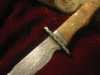 Shane, is this picture the sort of knife you'll be making?
Knifemaker and blacksmith Shane Stainton (www.forgedknives.net) makes a variety of historical and modern styles of knives. He comes to us from his smithy in upstate New York.
He describes the class thusly:
This will be a two day class in which we explore the proper making of a knife, its fittings, and the final finish of the work. We will make a clip point hunting knife with a guard and pommel, handled in wood or antler.
Subjects covered will be:
forging the entire knife closely to shape (i.e. the tang, bolster shoulders, and blade)
edge quenching for hamons
finish beveling
decorative file work
making a guard and slotting it for the blade
making a handle
making a pommel
assembling the knife
final fit and finish.
We will also discuss other basic blade profiles and handle styles such as 'slab handled' and 'built handled'.
Day one will be the forging to shape, filing, heat treatment of the blade, and the forging of fittings
Day two will be initial finish work, assembly, fit, and final finish.
Two very full days The tuition for this class is still to be determined.
Full Description, Dates, and Registration Information.
Back to TOP
Sharpening Your Knives
 Do you have fine kitchen knives that don't seem to cut as well as when you first got them? When you try to sharpen them, do they seem to cut worse, rather than better?
We'll show you how to put a keen edge on your good carbon-steel and stainless knives, straight and serrated, and either how to use the sharpening tools you already own, or how to use a simple, cheap, traditional bench stone.
If you have sharpening equipment, please bring it and we will work with that, we also have a number of sharpening stones you can use in the shop. Bring a couple of your own knives. Straight chisels and plane blades are also acceptable.
2 hours one meeting Tuition fee: $35
Full Description, Dates, and Registration Information.
Back to TOP
Sheath Your Knife
 In the first session of this class, we will demonstrate the process of making a custom sheath to fit oyur knife.
In the second session, you can complete your sheath or, if you've been zipping along, make a second sheath under supervision.
A variety of leathers and all the necessary tools will be provided. If there's a particular leather you have that you want to use, bring it and we'll see if it's suitable.
There will be an $8 materials fee for this class.
Don't forget to bring your knife with you!
6 hours, 2 meetings. Tuition: $145.00
Full Description, Dates, and Registration Information.
Back to TOP
Shop Maintenance
 A three-or-so hour session wherein we put stuff in the smithy to rights.
We'll tweak tongs, straighten, re-temper, and sharpen punches and chisels, tighten and wax hammer handles, de-rust rusty tools, replace broken ones...
3-or-so hours.
If you want to show up early, work it out directly with Carl. There is no fee per se, your work is your payment for whatever you might learn... if you happen to bring a little something for during or after, that'd be ok...
Full Description, Dates, and Registration Information.
Back to TOP
A Shopmade Tap and Die
We will go through the moves to make our own matching tap and die (non-standard in both thread profile and and pitch).
Using wire as a guide, we will hand saw (then perhaps file) a thread on a rod, then taper, flute, and harden it, then use that tap to thread a hole which we will then taper and flute to make a die, and with that we will be able to cut the real thread on a new rod, and turn that into the real tap.
Will it be useful?
Hmmmm... practically speaking... well... no, not particularly so.
A lot will be learned, a much deeper appreciation for nuts and bolts will be gained, it should be satisfying, entertaining, educational, and possibly... fun.
12 hours in four 3-hour meetings Fee: $390
Full Description, Dates, and Registration Information.
Back to TOP
Simple Knives
 In this class the student will start with a piece of high-carbon spring steel and make a small, simple, one-piece knife, suitable for cooking, eating, or general use. This class is intended for students with at least some previous experience in the smithy -- we require that the student have taken at least A Taste of Blacksmithing, and recommend Rudiments of Blacksmithing, or equivalent experience, or more. The more prior forging and heat management experience you have, the better your knife will come out.
There is another class, Nothing But Knives , for those who want to skip straight to making things with edges, though we still recommend at least some prior experience.
In this class the student will start with a piece of high-carbon spring steel and make a small, simple, one-piece knife, suitable for cooking, eating, or general use. This class is intended for students with at least some previous experience in the smithy -- we require that the student have taken at least A Taste of Blacksmithing, and recommend Rudiments of Blacksmithing, or equivalent experience, or more. The more prior forging and heat management experience you have, the better your knife will come out.
There is another class, Nothing But Knives , for those who want to skip straight to making things with edges, though we still recommend at least some prior experience.
Techniques include: straightening, drawing out, hammering high-carbon
steel, twisting, flattening, annealing, filing, grinding, hardening,
and tempering.
1 4.5-hour session, with a brief break. This class is no longer offered, it takes more than a single session to do anything like a proper job of making a knife.
Full Description, Dates, and Registration Information.
Back to TOP
Small (Jeweler's) Hammers
 Learn to make your own jeweler's hammers.
The sizes you want, the shapes you want, when you want.
Learn to make your own jeweler's hammers.
The sizes you want, the shapes you want, when you want.
The focus will be on learning the skills necessary to make small (less than three ounce) hammers for riveting, raising (anti- and syn- clastic), shaping, texturing... whatever.
Students should bring if possible:
- A handle (or handles) suited to the hammer(s) they plan to make
12 hours. Four meetings Fee: $420
Full Description, Dates, and Registration Information.
Back to TOP
Smith-to-Go
 Carl comes to your place and your set-up outside*.
Using your equipment, we can get you started, work on technique, form, and understanding, tweaking equipment, suggesting and maybe implementing improvements... or push you along in your skill-building.
We can also can arrange to do any of our usual classes, from A Taste of Blacksmithing to The DIY Off-the-Grid Guerilla Patternwelded Billet or a class/lesson/session to suit the student(s) needs, interests, and abilities.
At your forge we can accommodate one or two maybe even three students who are from the same epidemiologic bubble/pod/unit.
Most aspects of this experience are negotiable.
This is a privately-arranged class, Forge-to-Go sessions listed below have been scheduled by someone for themselves.
If you are here to register for a session, please be sure you are doing so for the right one.
If you'd like to discuss scheduling a Smith-to-Go session, please call Carl at 781 81oxide (781 816 9433) after 10am.
Calling is best, emails and texts can get lost in the flood.
*In this Covid time, I'm being _very_very_ cautious and am reluctant to go indoors.
Class length is negotiable, but typically 3 hours $100/hr, 2 hours minimum
Travel more than an hour from Waltham will be a bit extra
Full Description, Dates, and Registration Information.
Back to TOP
Special Open Smithy
 This is a special session of Open Smithy intended primarily for students of our special classes. These sessions are typically scheduled just before or after the classes in question and are intended to give those students a chance to continue their work with minimal interruption.
If you are one of our regular students and there is room, you are welcome to come and work, but please note that priority will be given to students of the current special class.
In general Open Smithy is a chance to work on your own projects or continue on a project begun in a class.If you would like to reserve a forge, call or email us at
If you just
show up, you're taking a chance that no one else called ahead and we
decided to go sailing, or that lots of people called ahead and there's
no room to work. $25 per hour 1 hr minimum 10-hour-package discount available
Full Description, Dates, and Registration Information.
Back to TOP
Strawberries and Art Festival
 We'll be demonstrating blacksmithing and offering our wares for sale.
There may be some amount of Striker Team activity through the day as needed and suited to the situation.
There will be lots of other merchants and artists, and some good food too.
Click for more info on the Festival
6 hours No admission fee
Full Description, Dates, and Registration Information.
Back to TOP
Striker Team
 We'll be learning to strike and to master, with single strikers and with teams of strikers. Striking directly and with set-tools. This is not so much a class in the usual sense as it is an ongoing practice session. There will be training for new people as they arrive, and practice for the more experienced. The projects we work on will be for the smithy or for sale by the smithy. Accordingly, the hourly rate for Striker team practice is lower than the usual Open Smithy rate.
Our Striker Team is available for both our own and our students' use, and performs at Fairs, Festivals, Exhibitions, and other opportunities for blacksmithing demonstrations, showing what it was like to do heavy forging in the old days.
To book the Striker Team for a special project, drop us an email.
To come see the Striker Team in action, check out our calendar for Fairs and Festivals at which we will be performing.
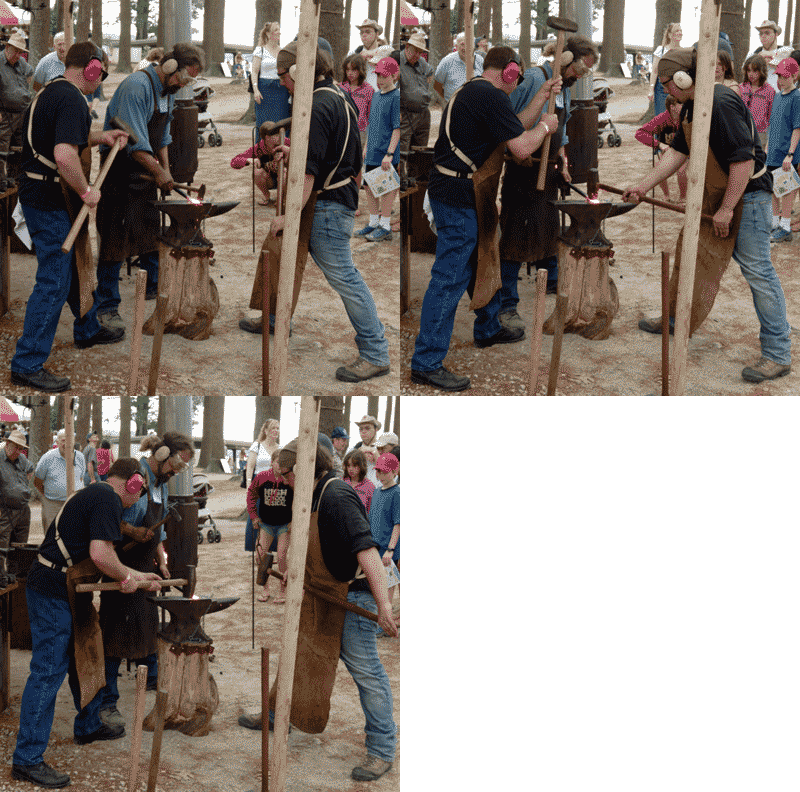
2 Hours (or so) Fee: $35
Full Description, Dates, and Registration Information.
Back to TOP
Sunday Afternoon at the Forge
We'll be spending a couple hours in the afternoon working with/on one of a variety of techniques or concepts. Generally there will be about 20 minutes of lecture, the rest of the time will be for the participants to work alone or together on the day's subject.
Exploring Fold Forming
We'll deal with some particular aspect of fold-forming for the first 15 or 20 minutes, after that, it's a chance to use the tools and cross-fertilize with other fold-formers.
Striker Team
A time to work on large iron in teams, with sledge hammers.
Twisting the Afternoon Away
We'll discuss some underlying concepts of twisting and why things come out the way they do, then try putting them to work making sample twists.
Students Show Off
A chance for our students to strut their stuff and show what they've been up to.
Watch and Do
We'll watch (or read) an instructional blacksmithing video (or book), then go try it out. The video (or book) will be available for reference all through the time.
Usually 2 hours, often followed by a few hours of Open Smithy $35
Full Description, Dates, and Registration Information.
Back to TOP
A Taste of Blacksmithing
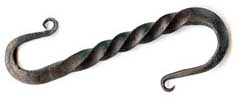
In this three hour class you will be introduced to the basic smithing
techniques of hammering, drawing-out, cutting, bending, and twisting.
Using these techniques and a coal-fired forge you will heat a piece of
iron to brilliant incandescence and with anvil, hammer, and tongs create
a decorative and useful 'S'-hook.
If you have a Gift Certificate for this class but none of these dates work for you, have a look at our Forged Bottle Opener class.
The skills taught are near-identical to those in this class, and we will happily apply a Taste Gift Certificate to the Bottle Opener class.
If you really enjoy "A Taste...", there is more you can do afterward.
4 hours one meeting... it's not unusual for it to run long Fee: $85
Full Description, Dates, and Registration Information.
Back to TOP
Tattersall Farm Day in Haverhill MA
 “Tattersall Farm Day" is a New England-style cultural and educational event for people of all ages.
Activities will include beekeeping, animal and farming demonstrations, crafts, art work, pony rides, hay rides, antique tractors and much more!
Live entertainment will be provided.
[like Real, Live, Honest-to-God, Actual Blacksmiths doing Real, Live, Honest-to-God, Actual blacksmithing -cw]
Food and beverages will be available
This event provides a rare opportunity to learn about New England farm life and its cultural and historical influence on the City of Haverhill.
Proceeds from Tattersall Farm Day will assist in the rebuilding of the barn.
Much of the day Admission fee: Currently Unknown
Full Description, Dates, and Registration Information.
Back to TOP
Teen Knives
In this class the student will start by learning the basic moves of
knife-making on a piece of mild steel, ending up with a letter-opener
if all goes well, and then move on to a piece of high-carbon spring
steel and make one or more small knives, suitable for cooking,
eating, or general use.
Focus will be entirely on making a knife; only those tools,
techniques and concepts needed for knife making will be addressed. The
fires will be managed by the instructor.
Techniques include: straightening, drawing out, forging high-carbon
steel, twisting, flattening, annealing, filing, grinding, hardening,
and tempering.
15 hours in five 3-hour meetings Tuition: $450 (includes all materials)
Full Description, Dates, and Registration Information.
Back to TOP
Tent Stakes and Open Smithy
A chance to make good solid tent stakes.
This is sort of a focused Open
Smithy* time. The main intent will be to make, you guessed it,
tent stakes.
Techniques: drawing-out, cutting,and bending. Minor coaching on form
and technique will be available. We have four coal forges, so that many people (or groups) can be
working at once.
Some protective gear is available. If you're bringing a group you may
need to bring some of your own eye and ear protection. We have aprons, ear muffs, and safety glasses
enough to protect eight people. Bring your own stock or buy some from us, we have 1/2" square, 3/8"
square & round on the rack.
*If you really want to make something else while everyone else is
making tent stakes, feel free, you can do as you please with your forge
time.
$25/hour
Full Description, Dates, and Registration Information.
Back to TOP
Toasting Forks

In this class we will make a long-handled two-tined fork suitable for cooking at the grille or over the campfire.
The techniques involved will be splitting, drawing out, curling & bending, and if there's time, twisting and draw-filing.
This fork design can also be modified slightly to serve as a most excellent marshmallow toasting fork (S'mores anyone?).
3 1/2 hours, one meeting $123
Full Description, Dates, and Registration Information.
Back to TOP
The Topsfield Fair
 We are the blacksmiths at the Topsfield Fair again this year.
If you are a smith, and you'd like to demonstrate at the fair, please contact us, we'll probably welcome the break.
We will be in "Kiddieland" on "Country Way". [hey, we don't name these things.] If you come in the main gate on Rt 1, we are around to the right (due South of the Administration building).
If you come in from the "Riverside" parking area which is south of the fairgrounds on Rt.1, come straight in and turn left after the cider people. we are to the left across from the Turkey Leg vendor.
More info on the fair
10am to 11pm, except the 1st Friday, which is 1pm to 11pm Click here for the admission fee schedule, if you're helping us, we can comp you in.
Full Description, Dates, and Registration Information.
Back to TOP
Tripods
 In this class we will make a tripod for cooking over a camp fire.
This is a good solid design that stands well and can also be arranged as two
verticals with a horizontal either as a spit or as a bar for
hanging utensils from.
Techniques: hacksawing, drawing-out, bending, twisting
(optional)
The parts disassemble easily for transport. You'll need a few 'S' hooks
or a trammel hook to adjust the height of your cookpot. (Watch for a
trammel hook class coming soon).
2 hours one meeting
Fee: $80 + $8- $12 materials fee depending on size
of tripod
Full Description, Dates, and Registration Information.
Back to TOP
The Trivet, a Matched-Scroll Project
 In this class, we will sharpen our eye and improve our bending skills. We will make three matched one-ended scrolls with the ends bent down to make feet. We will collar them together with six collars to make a highly functional, sturdy, and possibly elegant three-legged trivet.
The student will have a choice whether to make it more suited to table-use or hearth-use.
If you have taken Rudiments III and you made the pair of scrolls, we are discounting this class for you.
Note: This trivet is what we make now in Rudiments III, if R3 is on your list, you ought skip this class until you decide afterward that you want to do it again.
6 hours, 2 meetings Fee: $210 ($175 for past R3 students who made the pair of scrolls)
Full Description, Dates, and Registration Information.
Back to TOP
A Tween's First Taste of Blacksmithing
 The discovery of iron and how to work it changed human history. Tools, weapons, and daily life haven't been the same since. This is your "tween's" chance to learn to control one of the basic elements of modern human life.
In this class he or she will be introduced to the basic smithing techniques of hammering, drawing-out, cutting, bending, and twisting. Using these techniques and a coal-fired forge your child will heat a piece of iron to brilliant incandescence and with anvil, hammer, and tongs create a decorative and useful hook designed to be driven into a post or beam.
This class is not limited to tweens (Yes, Mom or Dad, you can take the class, too), but we do try to make sure that the tweens outnumber the older students. The material presented is similar to that in our regular "A Taste of Blacksmithing" and "A Teen's First Taste of Blacksmithing" classes, but with less detailed lecture content, to better suit younger students, and a simpler project -- a blunt-ended drive-hook.
Enrollment is limited to four students, so that they don't have to share tools and workspace, and each student gets more working-time and more attention from the instructor than in the teen or adult versions of the class.
one meeting 3.5 hours with a 1/2 hour lunch break. Fee: $100
Full Description, Dates, and Registration Information.
Back to TOP
Twisting the Afternoon Away
 The twist is a very common ornament in blacksmithing, largely because the aesthetic return for your labor investment is huge.
We'll talk about how and why twisting does what it does and how heat, cross section, size, and interruptions affect how stock twists. Then we'll play with as many variations as the class can come up with.
One meeting, 2 hours (with Open Smithy following for those who wish to stay on) $35
Full Description, Dates, and Registration Information.
Back to TOP
Two Weeks More Smithin'
 This is a two-week extension of a class, either to finish the intended class work, or to explore just a little bit more.
6 hours in two 3-hour meetings Fee: $175
Full Description, Dates, and Registration Information.
Back to TOP
Tying a Knot in a Bar of Steel
 The project for this class will be tying an overhand knot in a length of round rod.
It's a simple knot, one of the simplest, but it will serve to demonstrate the principles necessary to tie more complex ones.
A knot can serve as an ornament in a bar in many situations, a figure-eight knot can make a nice handle on a tool that doesn't mind a bit of fanciness, and especially on your forge-poker and shovel for when you're out doing demos. If your demo tools don't brag for you... make better ones.
We will be using Zoom as the group-meeting app.
Clicking the link above will tell you what you need to make it go on your device.
The Zoom meeting URL will be emailed out at least an hour before class and the meeting will be started 15 minutes before official class start so we can check the tech and maybe visit each other's smithies.
People on the standby list will have the option of auditing the class (see the fees below) but will be asked to turn off their cameras and microphones until the end of class (emergencies excepted).
The student must have: (please read this carefully)
- Their own blacksmithing set up:
- A forge, lit and running by the beginning of class, type is unimportant
(being able to back-down a gas forge while we're talking would likely be good)
- An anvil-like object
- A hammer, 1 to 2 pound, no larger.
- A smaller hammer and/or a softie and a waterlog (a flat wooden hardy tool and a hefty stick for hitting things without leaving marks. Soaked in water.)
- Tongs to hold the stock, if your stock is short, another pair also, or a pair of pliers
- A vise, solidly mounted. You'll be pulling sideways in it.
- A vise-grip-like tool for pulling on the end of your stock is very useful, especially if it's short.
- A bending 'U' would be useful but not vital
- Eye and ear protection
- Ear buds or somesuch that fit under your ear protection so that you can hear me while you're hammering.
- A device that will run Zoom, has a camera, a microphone, and a decent 'net connection while in your work area.
- The ability to move that device around the work space so I can watch you work from helpful angles. A photographer's tripod and some way to hold your device on it would be marvelous
- Enough light. So both of us can see what you're doing
- If you're willing to give a brief tour of your set-up before class, that'd be cool.
Materials
At least 12" of 3/8" or thinner round steel, preferably mild. Thinner (1/4") is better. 24" or longer is better.
If it's 18" or more long you won't *need* the stock-sized tongs.
2-ish hours Fees: Participating $50, Auditing - Free, come see how it works.
Full Description, Dates, and Registration Information.
Back to TOP
Viking Woman's Knife
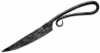 We will be forging, heat-treating, and sharpening a knife in the style known as a Viking Woman's Knife. The name comes from them being found near the hip in the graves of viking-era women.
The knife will have a long drawn-out tang bent around to make the handle. We will start directly in high-carbon spring steel. The knife is expected to be slim and light, close attention to the work in the fire will be vital.
If there is time on the last day we may have a chance to get a start on a leather sheath, to be finished at home.
Nine hours in 3 three-hour sessions Fee: $375 per person
Full Description, Dates, and Registration Information.
Back to TOP
Waltham Day
 An event on Waltham Common celebrating Waltham itself.
We'll be demonstrating, promoting our classes to the locals, selling from our modest stock of items, and taking the occasional challenge.
There will be all manner of other stuff going on too, more info HERE Class tuition to be determined.
Full Description, Dates, and Registration Information.
Back to TOP
Waltham Mills Artists' Association Open Studios
 The WMAA Open Studios takes place each year on the first weekend of November. The 80-plus artists of the WMAA open their homes and studios to the public. Works of all media imaginable are demonstrated, displayed and discussed.
PHF will be there displaying and offering for sale a variety of ironwork, and touting our classes.
Carl will be doing a live blacksmithing demonstration outside and will have ironwork and sculpture on display and for sale inside.
Visit the WMAA website for more information.
Note!: This is not at the Smithy. This is at 144 Moody Street in Waltham, right near the Charles River.
Directions to the WMAA Buildings.
You will need to park elsewhere unless you have handicapped plates. There are public lots just across the Charles that are a brief walk away.There is no admission fee...
Full Description, Dates, and Registration Information.
Back to TOP
Waltham RiverBeat Mini Class
 In this half-hour mini-class the student will use:
a coal forge
a bellows
a hammer
and tongs
to bend and forge a length of 1/4"-square mild steel into a hook that may be nailed or screwed to a wall, post, beam, bench... pretty-much anywhere you might wish to hang keys, a purse, a bag, a jacket, a tool... a useful item to take home.
The class will be held on Moody Street, on the bridge over the Charles during Waltham RiverBeat.
one half-hour single session Fee: $20
Full Description, Dates, and Registration Information.
Back to TOP
Waltham Riverfest
 This will be our second year at the Riverfest, and we expect to be just one of many interesting demonstrations, activities, and entertainments.
We'll be demonstrating from 9am to 3pm.
We won't so much be _on_ the river, as _over_ it, as in 'above', as in on the Moody Street Bridge. It ought to be pleasantly breezy albeit open to the sky.
www.walthamriverfest.comFree!
Full Description, Dates, and Registration Information.
Back to TOP
Watch City Steampunk Festival
 What is 'Steampunk'?
It has been described as "the science fiction of the steam age"; a re-imagining of the modern world through the eyes of the likes of Jules Verne and H.G. Wells but with the benefit of modern hindsight. (mad)Inventors, steam-power, rogues, airships, adventurers, clockwork, explorers, corsets, jewelers, top hats, pocket watches, gas-light... and of course, blacksmithing.
It promises to be an interesting crowd.
There is more info on the festival here.
The entry fee for INDOOR events is $4 for children $6 for adults. Everything else is free!
Full Description, Dates, and Registration Information.
Back to TOP
Weekly Zoom Demonstration and Social Time (not reeellly a class)
 Each week on Wednesday, there's a Zoom call that starts at 7:30 Eastern with a bit of chatting and at 8pm the demonstration begins.
Typically it's Carl working through some aspect of a project, sometimes it's something he's solid on and knows what to say when, and sometimes you get to watch and hear him figure it out on the fly.
Some find that entertaining too.
And sometimes he takes a request from the audience.
So far the demos have been (not in any order):
- Collaring
- Basket Twist Handle
- Hot-punching a Trammel Hook
- Date Punch
- A Snake Head (by Willow Zietman)
- Corkscrew
- The Bodkin Point
- A Dog-faced Wall Hook
- Circle-dot-punch
- Mini Bush Axe
- Bodkin Arrowhead
- Pineapple Twist and a Variant
- Center-tang blade
- Figure-8 knot in 5/16" round
- Dishing a spoon on the flat of the anvil
- The DIY, off-the-grid, guerrilla, Pattern-welded billet
- Nutcracker
Most demonstrations last between 30 and 60 minutes and are framed-up as lessons.
We have a cantilevered camera rig that allows us to give better views of
what's going on than are generally available in live in-person classes,
and a second camera for showing the smith's posture and placement.
Demonstrations are live and questions are welcomed.
We are recording the demonstrations to be edited only as much as necessary to put up on YouTube.
Click here to go straight to the meeting (only works during the time mentioned above). Coming in late is fine.
Note: During the demo, attendees are asked to turn off their cameras,
and if there's background noise, their microphones.
This way the views from the smithy can be as large as possible on everyone's screens and distracting noise is minimized.
If you register for the class (below), time allowing, you will receive an email at 12:05am Thursday morning reminding you about this auspicious occasion.
The email will also offer advice about what to wear and try to point you to our Online Waiver, which you are welcome to execute, but that's up to you.
Typically 3 hours Fee: No charge, click the link and come see.
Full Description, Dates, and Registration Information.
Back to TOP
Whittle Tang Knife
 The whittle tang is a fairly quick, easy, and medieval way to hold a handle onto a knife.
We'll be making a practical*, small-bladed utility/eating knife, starting with a piece of automotive coil spring.
In the first meeting we'll forge the tang then the blade, hot-file to shape and heat treat the blade in the style we use in our Nothing but Knives class. In the second meeting we will install and finish the handle.
If time allows, we will discuss sheath options.
If you have wood (or antler, or bone) that you want to use as the handle, bringing it to the first meeting would be helpful.
*Please check any fantasies about making a "... THIS is a Knoife!" at the door.
6 hours in two meetings Fee: $210
Full Description, Dates, and Registration Information.
Back to TOP
Winslowshire Renaissance Festival
 We'll be doing some demonstrations of traditional blacksmithing techniques, making household (and Renn Faire!) objects, and showing off our Striker Team -- several smiths working with sledge hammers on a single anvil.
The two day event will be on June 25th and 26th of 2011 from 11 am to 5 pm each day.
For more information about the event, please go to the website at http://www.winslowshire.com
We'll be doing some demonstrations of traditional blacksmithing techniques, making household (and Renn Faire!) objects, and showing off our Striker Team -- several smiths working with sledge hammers on a single anvil.
The two day event will be on June 25th and 26th of 2011 from 11 am to 5 pm each day.
For more information about the event, please go to the website at http://www.winslowshire.com
Directions:
The directions on the Faire's Site are good.
But note that there is a hiccup in the signage:
As you get close, there are square yellow signs with big black arrows. At the last turn they switch to a white rectangular sign. There is a square yellow sign there too, but it doesn't look the same as the others.
Admission is $12.00 for adults and $7.00 for kids ages 5 – 13, and kids under 4 will be free. Specials include: Two day pass for $18.00, Come dressed in Renaissance Attire for $2.00 off and a Veterans’ Discount of $2.00 (must show military ID). Specials may not be combined.
Full Description, Dates, and Registration Information.
Back to TOP
Worcester stART on the street
 We will be one of sixteen crafts booths doing demonstrations on Park street in Worcester. The street will be closed to automotive traffic, so bring your walkin' shoes.
We'll be demonstrating in our usual fashion, making knives, hooks, dragons, and working in some Striker Team if we have the strikers to do it.
Our space is near the corner of Elm and Park, on the grassy area roughly across from the J.N.Phillips Auto Glass place, about half-way along Park street.
More information Here.
Just the one day No admission fee.
Full Description, Dates, and Registration Information.
Back to TOP
A Wrought Frying Pan
 In this class you'll make a ~10" frying pan starting with a disc of 10ga mild steel and a length of flat-stock.
You'll slot-punch the end to make a ring on the handle, taper to improve the balance (and elegance) of the pan, you'll dish and raise the sheet steel to to form the "bowl" of the pan, and rivet the two together making a solid whole.
This is a chance to make a pan that works well over a campfire where conventional fry-pan handles are way too short.
These same basic techniques can be used in the making of ladles, egg spoons, and XXXsomethingXXXelseXXX.
Roughly 6 hours, (it'll be a full day) Tuition:$7000
Full Description, Dates, and Registration Information.
Back to TOP
Wrought Iron Bracelets
 Make a wrought iron bracelet in just a few hours. Use traditional
blacksmithing techniques to make a distinctly non-traditional item.
Work an iron bar with fire and water, hammer and tongs, vise and
anvil. Learn about heat control, hammer control, and self-control
while creating a ready-to-wear bracelet with a tapered, sinuous motif.
Techniques will include forging (flaring and drawing to a taper),
bending, and twisting.
Make a wrought iron bracelet in just a few hours. Use traditional
blacksmithing techniques to make a distinctly non-traditional item.
Work an iron bar with fire and water, hammer and tongs, vise and
anvil. Learn about heat control, hammer control, and self-control
while creating a ready-to-wear bracelet with a tapered, sinuous motif.
Techniques will include forging (flaring and drawing to a taper),
bending, and twisting.
3 hours (and maybe a little) Fee: $75
Full Description, Dates, and Registration Information.
Back to TOP
Wrought Iron Candlestick
 This class is specifically geared to the production of a simple, elegant and functional candlestick. In the process of making it, you'll cut threads with tap & die, form a tenon, forge pipe, and work with sheet steel.
When finished with this class, the student should be able to use Open Smithy Time to make as large a set of candlesticks as they desire.
This class is seven hours long, in two sessions, the first of which is three hours long, the second usually four hours. No longer offered
Full Description, Dates, and Registration Information.
Back to TOP
The Wrought Iron Churchkey
 We will be making a churchkey-style bottle opener from 1" x 1/4" mild steel.
(They seem to be all the rage among blacksmiths these days, I blame Mark Aspery)
Techniques involved:
Chamfering
Punching
Drawing/stretching on the horn
Using a set-tool
Bending
and finally, prying.
3 hours, 1 meeting. Fee: $125
Full Description, Dates, and Registration Information.
Back to TOP
Zero to Blacksmithing
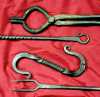 This is a chance for a teen with no experience to engage with an ancient and vital craft.
We'll cover the content of our 'A Taste of Blacksmithing' wherein we learn safety and basic hammer technique and make an 'S'-hook, and our 'Rudiments of Blacksmithing I' class where we make a barbeque fork and a pair of blacksmithing tongs, in the process learning how to run a variety of coal forges.
For adults we cover this content in 5 3-hour meetings, in this class we do it in 6 2.5-hour meetings, a pace we've found better suited to our younger students. $480
Full Description, Dates, and Registration Information.
Back to TOP
Zero to BlacksmithingII
Zero to Blacksmithing is a chance for a teen with no prior smithing experience to engage with an ancient and vital craft. This is the second segment of the class, covering material equivalent to that covered in our adult class Rudiments of Blacksmithing II,
in which we make a hardened and tempered punch and chisel and use them to make a steel "dragon" head and also get in a lot more practice with the hammer, and with temperature control.
For adults we cover this content in 4 3-hour meetings, in this class we do it in 5 2.5-hour meetings, a pace we've found better suited to our younger students. $400
Full Description, Dates, and Registration Information.
Back to TOP
Zero to BlacksmithingIII
Zero to Blacksmithing is a chance for a teen with no prior smithing experience to engage with an ancient and vital craft. This is the third segment of the class, covering material equivalent to that covered in our adult class Rudiments of Blacksmithing III, including collaring, working with pipe, making matching parts, scrollwork, and tapping and threading.
For adults we cover this content in 4 3-hour meetings, in this class we do it in 5 2.5-hour meetings, a pace we've found better suited to our younger students. $400
Full Description, Dates, and Registration Information.
Back to TOP
